
SaaS valuation, weekly recap
A deep dive into Forward EV/Sales, EV/Gross Profit, PSG, P/E, Rule-of-40 and shareholders Dilution — analyzing how growth, efficiency, market expectations shape valuations across the SaaS landscape.

Each week, I’ll publish a recap breaking down the key valuation metrics across the SaaS sector, highlighting where growth, efficiency, and market expectations intersect.
This week, the valuation gap between SaaS companies with seat-based pricing models and those with hybrid pricing models widened further. Average valuations for hybrid pricing model companies increased, while two earnings reports had a particularly significant impact on the broader SaaS market.
Snowflake’s quarterly report challenged the bearish narrative that Agentic AI and LLMs will disrupt the entire SaaS sector. Snowflake delivered exceptionally strong results, beating its own revenue guidance by 5.3%, one of the strongest beats in the company’s history. Management also significantly raised full-year guidance by 3.2%, signaling confidence in the company’s future growth trajectory. In addition, Cortex Code and Snowflake Intelligence, both launched relatively recently, are already showing strong traction. Following this earnings report, SaaS stocks broadly moved higher.
MongoDB’s quarterly report was also particularly noteworthy. From a technical perspective, it was a strong quarter. MongoDB beat its own revenue guidance by 3.6% and raised full-year guidance by 2.1%. The stock initially surged 24% following the results, but during the conference call, the gain faded to just +0.5%. Management explained that although AI adoption is accelerating, revenue is still primarily driven by core workloads, which cooled investor enthusiasm. For MongoDB, AI adoption remains in its early stages, and management honestly stated that it cannot yet provide clear data regarding future revenue streams from AI agents, despite the company’s ambition to become the “memory layer” for AI agents.
MongoDB’s earnings report is important because it illustrates how SaaS companies are currently standing at a crossroads.
On one side are companies that may lose competitiveness to startups built around LLM-native architectures. For these companies, margins could come under pressure, revenue growth could slow, and stock prices could continue to decline.
On the other side are companies such as Snowflake, Datadog, and Cloudflare — businesses that are likely to become beneficiaries of AI adoption. These companies are already seeing benefits from AI while strengthening their competitive positions. They possess significant economic moats and can be viewed as AI-resilient businesses. Their revenue growth is accelerating, while business margins remain stable or are likely to improve over time.
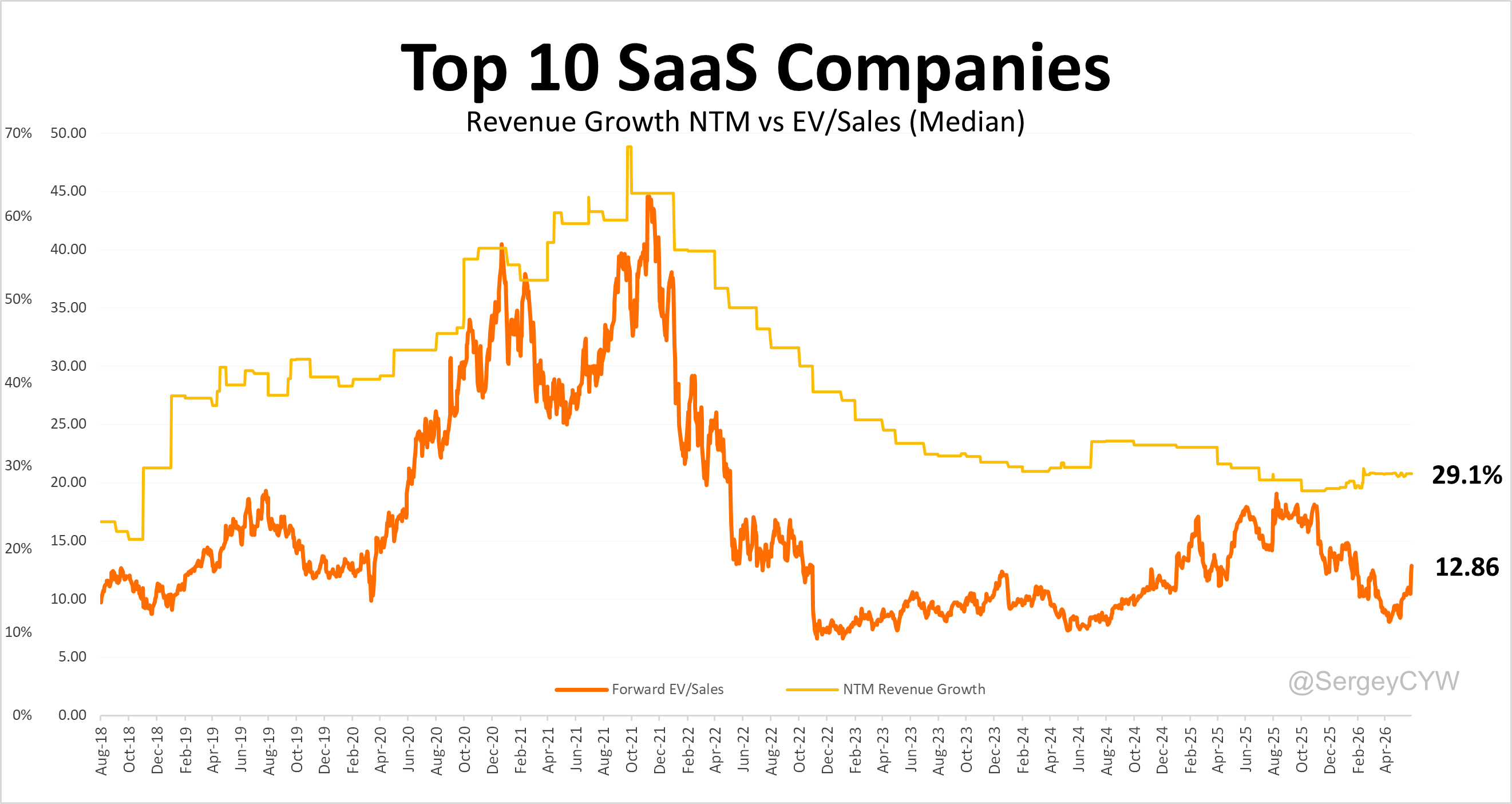
I believe the appreciation in SaaS stocks that benefit from AI could be substantial. The valuation multiple for the top 10 SaaS companies has risen significantly over the last month, reaching 12.86x, approaching the average levels seen in 2019.
Table of Contents
Forward EV/Sales vs. NTM Estimated Revenue Growth (current and historical chart), including the top 10 fastest-growing SaaS companies
Forward EV/Gross Profit vs. NTM Revenue Growth
PSG (Price/Sales/Growth) — current and historical chart
Forward P/E vs. NTM Revenue Growth
Rule of 40
Rule of 40 vs. Forward EV/S Multiple
Pricing models (Seat-Based vs. Consumption and other Subscription models)
Dilution (SBC/Revenue and Outstanding share growth)
Forward EV/Sales to NTM Revenue Growth
SaaS companies are typically valued by comparing their EV/Sales multiple to their projected NTM (next twelve months) revenue growth. Forward revenue expectations matter: they give investors a clearer view of the company’s future potential rather than its trailing performance.
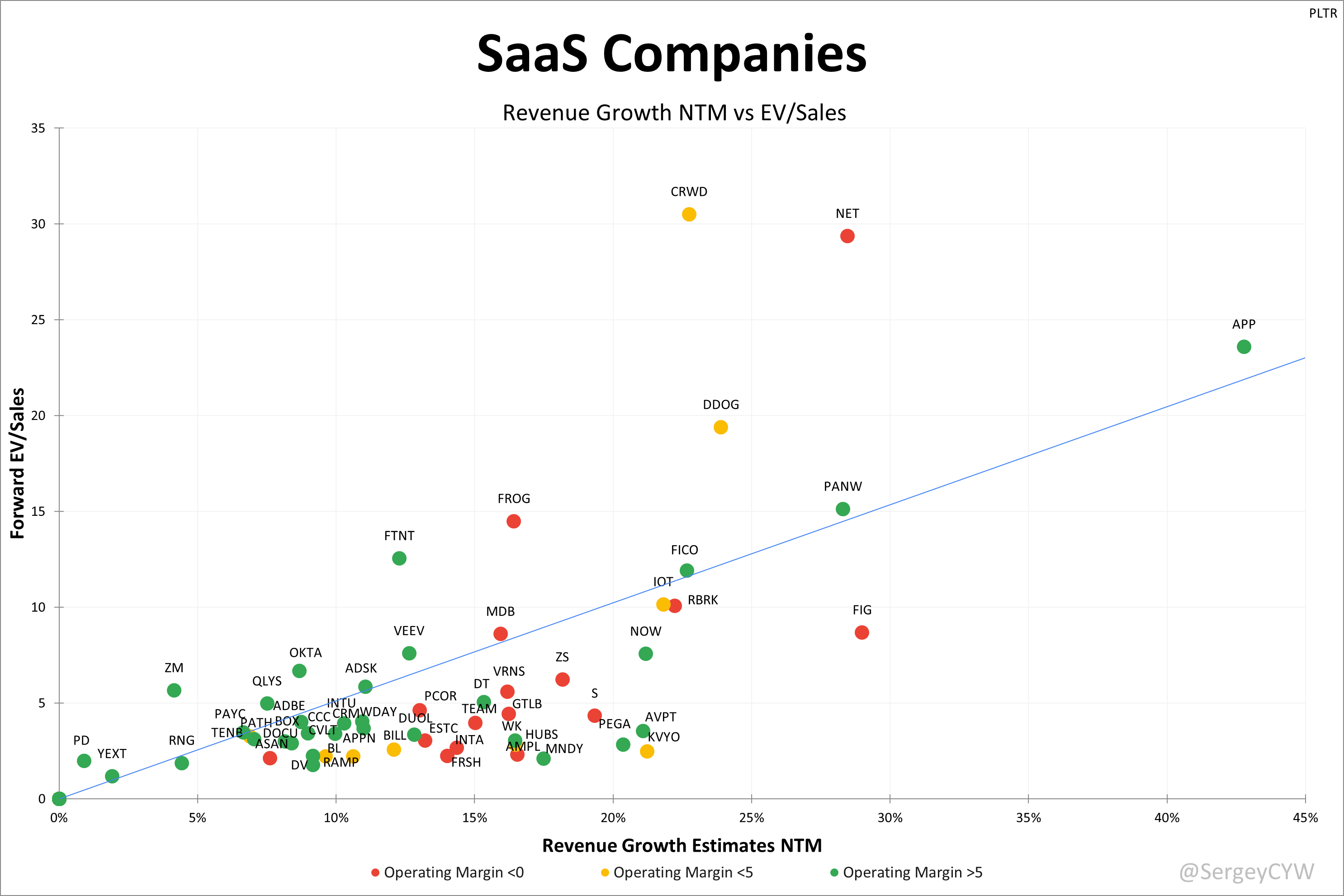
Note: For readability, $PLTR was excluded, as it currently trades at an Forward EV/Sales of 43.7 and +63.1% estimated Growth Rate. The chart includes software companies with an enterprise value above $1B and gross margins over 70%.
To provide deeper valuation context, I also include Operating Margin across the EV/Sales, EV/Gross Profit, and Rule of 40 charts. Operating profitability directly influences valuation — companies with sustained positive margins deserve higher multiples than those operating at a loss.
On the charts:
Red: Negative operating margin
Yellow: Operating margin below 5%
Green: Operating margin above 5%
In this case, I used the GAAP Operating Margin from the most recent quarter. This highlights the latest trends and helps identify companies that have recently achieved operating profitability. However, for seasonal businesses, this data may be distorted.
The median EV/Sales for SaaS companies stands at 3.96, with analyst-estimated NTM revenue growth of 14.2% YoY.
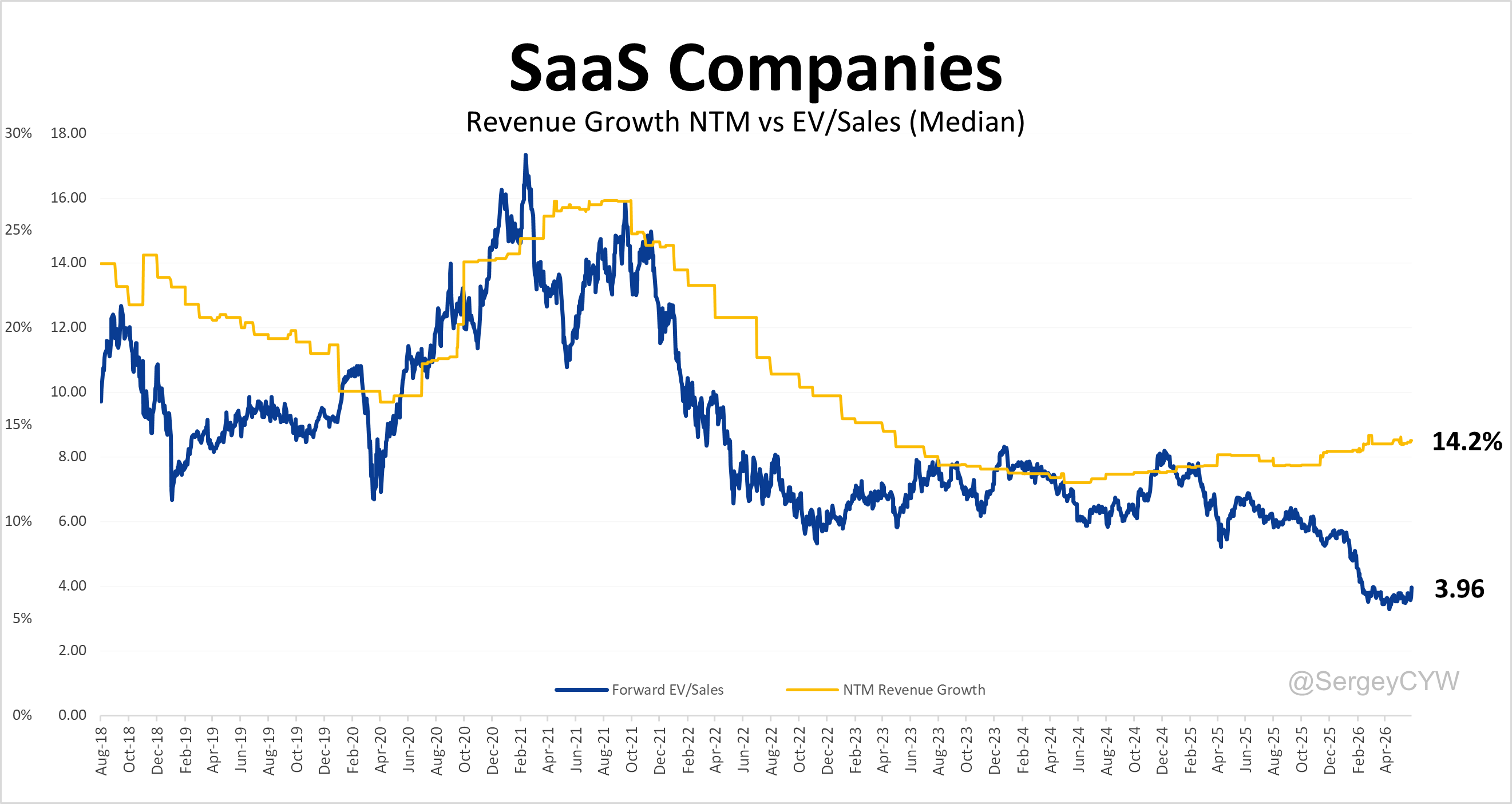
The dataset includes 85 public subscription-based software companies, along with historical data from several businesses that are no longer publicly traded.
For the top 10 fastest-growing SaaS companies, the median EV/Sales multiple is 12.86, paired with 29.1% NTM revenue growth.
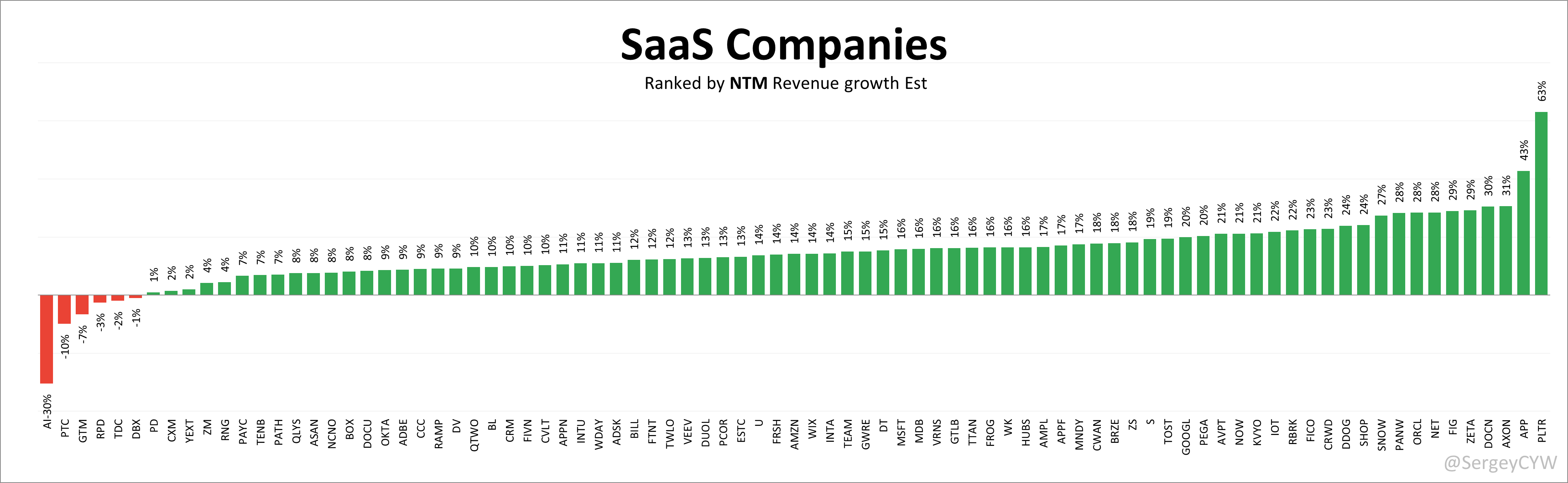
Evaluating growth stocks using forward projected revenue growth is crucial for investors because it provides insight into the company’s future potential, rather than just its current performance.
Forward EV/Gross Profit to NTM Revenue Growth
The EV/Gross Profit (GAAP) multiple relative to projected NTM revenue growth incorporates product efficiency, reflected through gross margin. Gross margin is a critical measure for software companies — consistently high or improving margins usually indicate strong competitive positioning and long-term potential.
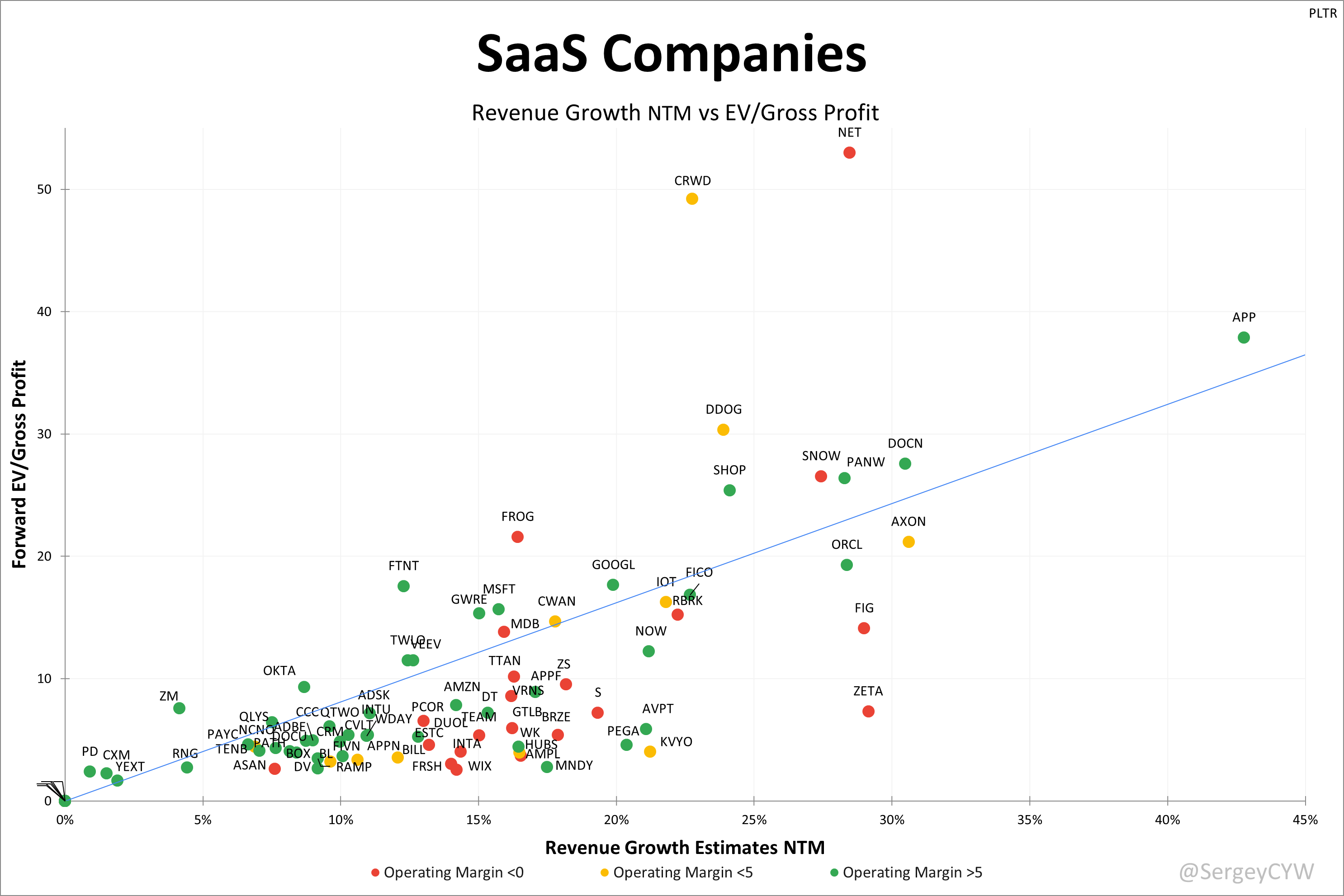
Note: $PLTR was removed from this chart as well, given its elevated 82.2 Forward EV/Gross Profit multiple. Only companies with EV > $1B and gross margins above 70% are included.
PSG (Price/Sales/Growth)
The Price/Sales/Growth (PSG) ratio adds growth discipline to the traditional P/S ratio, helping investors evaluate whether a premium valuation is backed by actual revenue expansion. This is especially relevant in software, where high P/S ratios often reflect expectations of scalable growth.
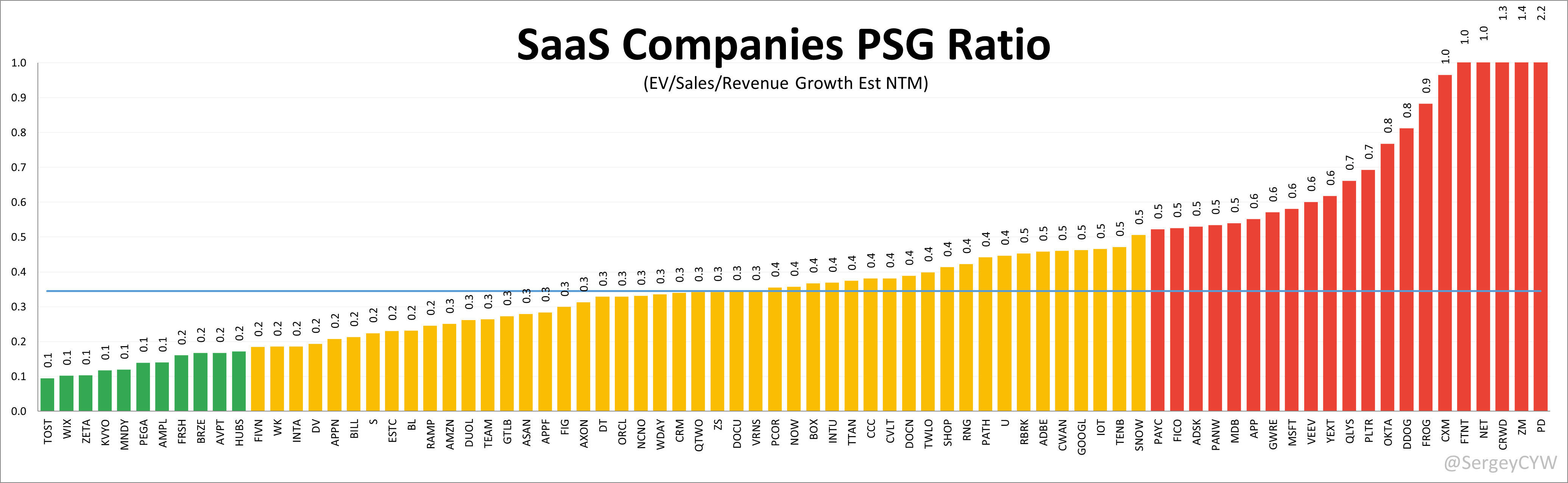
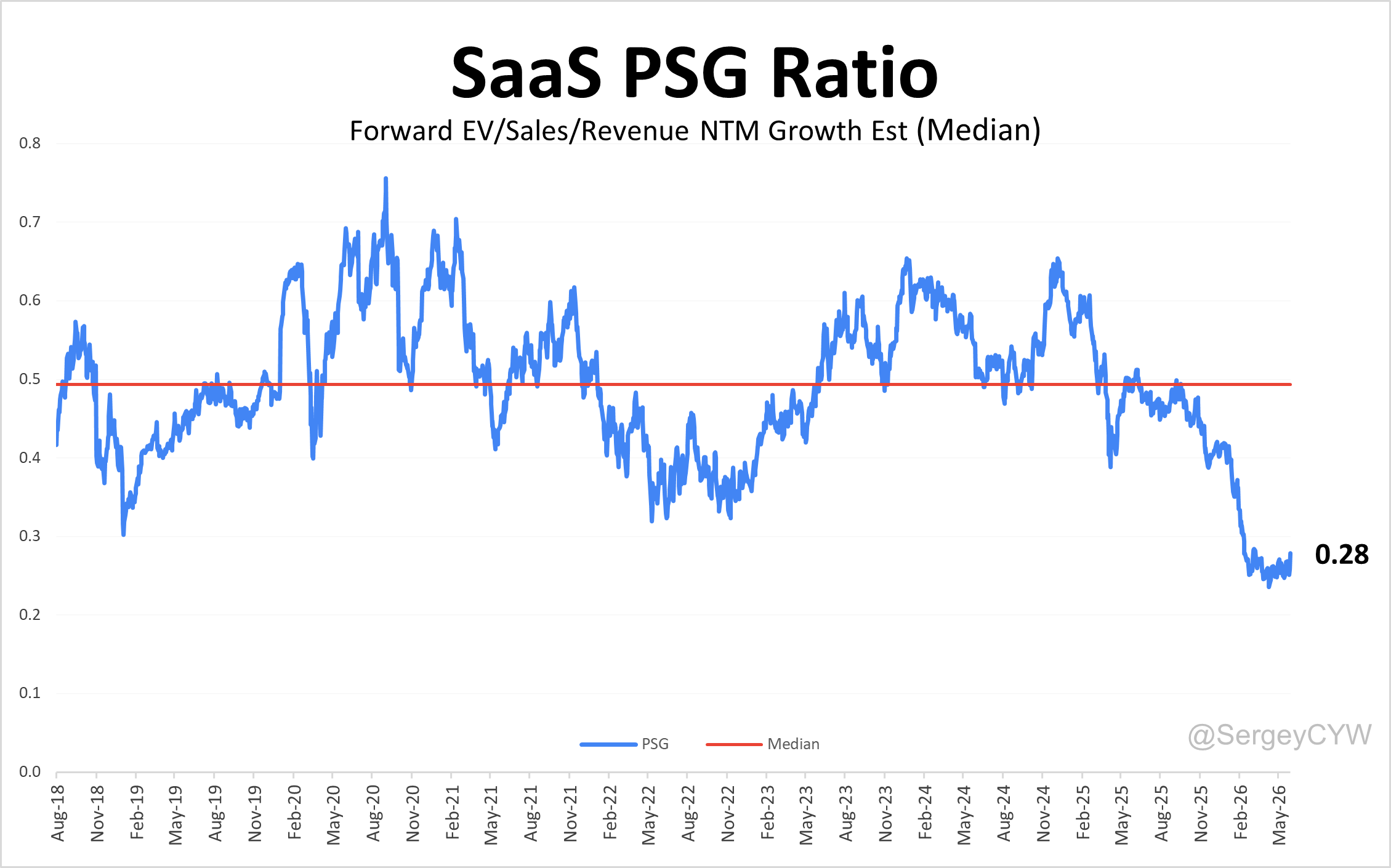
For calculations, I use: EV / NTM Estimated Sales / NTM Revenue Growth
The historical chart for the median PSG multiple among SaaS companies shows a median of 0.28, compared with a long-term historical median of 0.49.
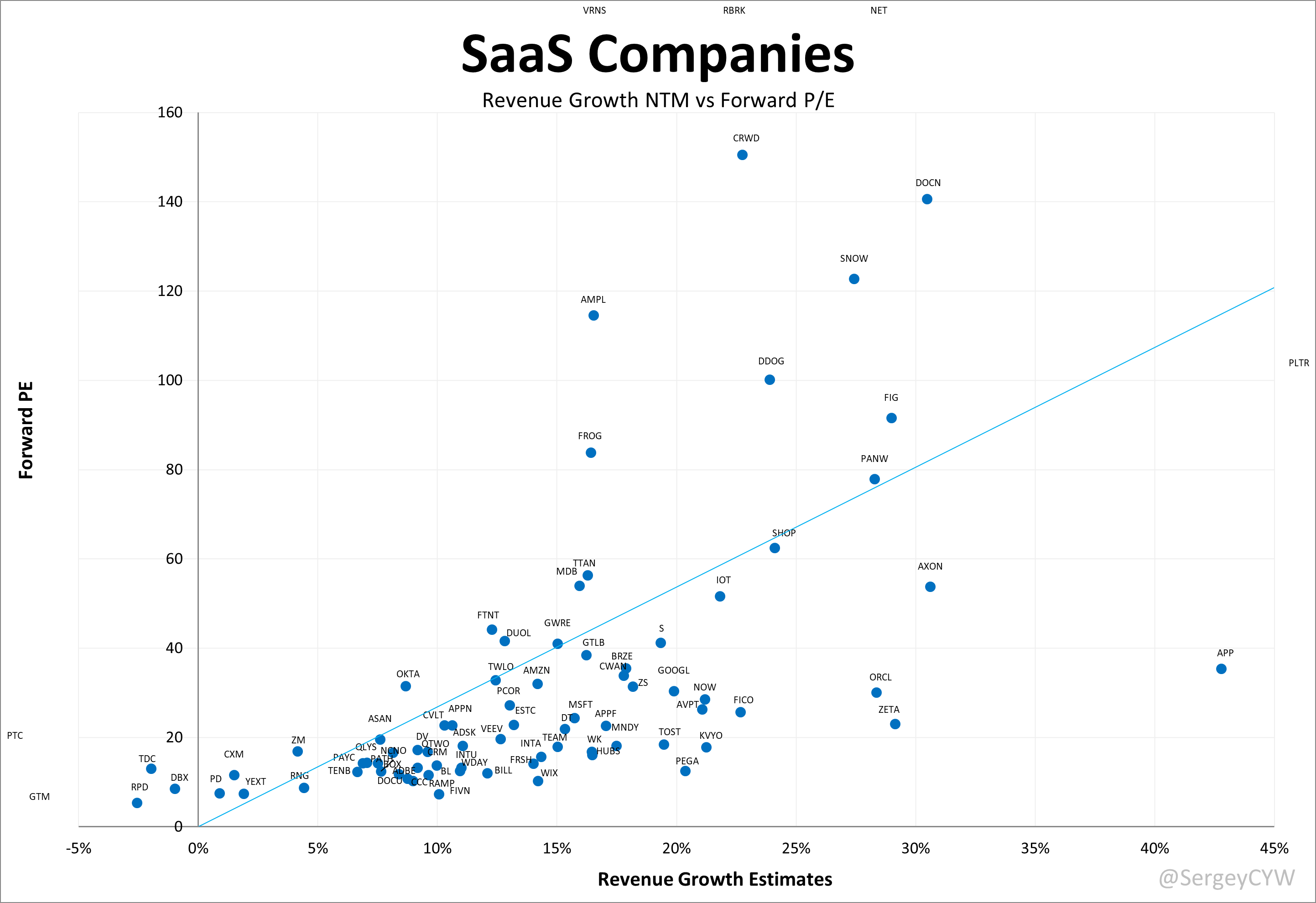
Forward P/E to NTM Revenue Growth
An alternative perspective would be a valuation chart based on the Forward P/E ratio relative to analysts’ revenue growth forecasts.
Rule of 40
The Rule of 40 remains one of the most practical metrics for assessing the balance between growth and profitability in SaaS. A score above 40% generally signals strong operational performance and makes a business more compelling from a capital-efficiency standpoint.
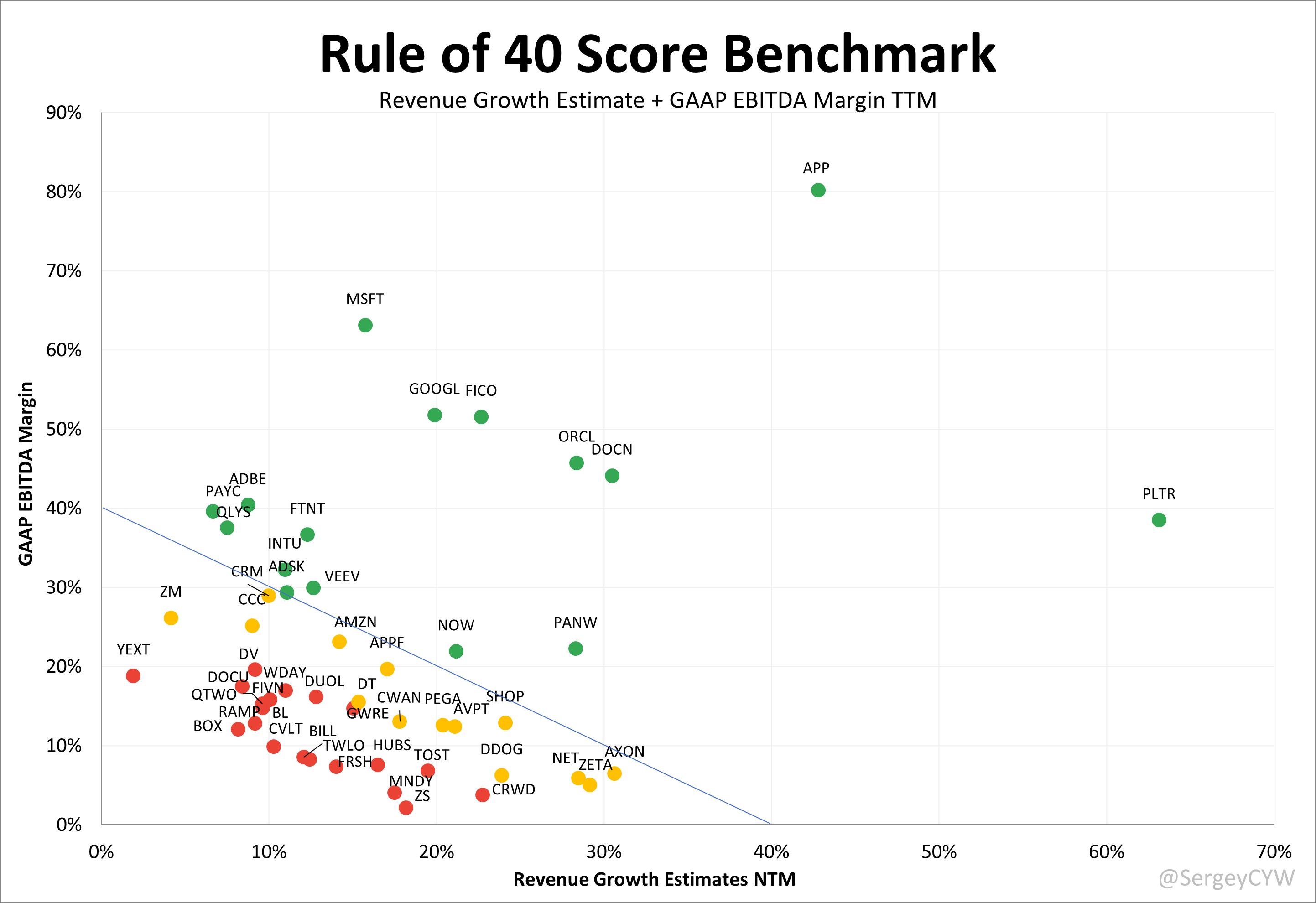
For this chart, I combined GAAP EBITDA Margin (TTM) with revenue growth estimates (NTM), creating a clear view of efficiency relative to future growth.
The Rule of 40 also allows useful comparisons across companies at different maturity levels.
Rule of 40 vs Forward EV/S Multiple
Comparing the Rule of 40 to Forward EV/S multiples highlights how the market prices efficiency versus pure top-line growth.
The Rule of 40 captures operational discipline.
EV/S reflects revenue expectations alone.
Using both provides a more complete framework for evaluating whether investors are paying a reasonable price for sustainable growth.
A company above the 40% threshold tends to attract more interest from investors who prioritize both profitability and forward momentum.
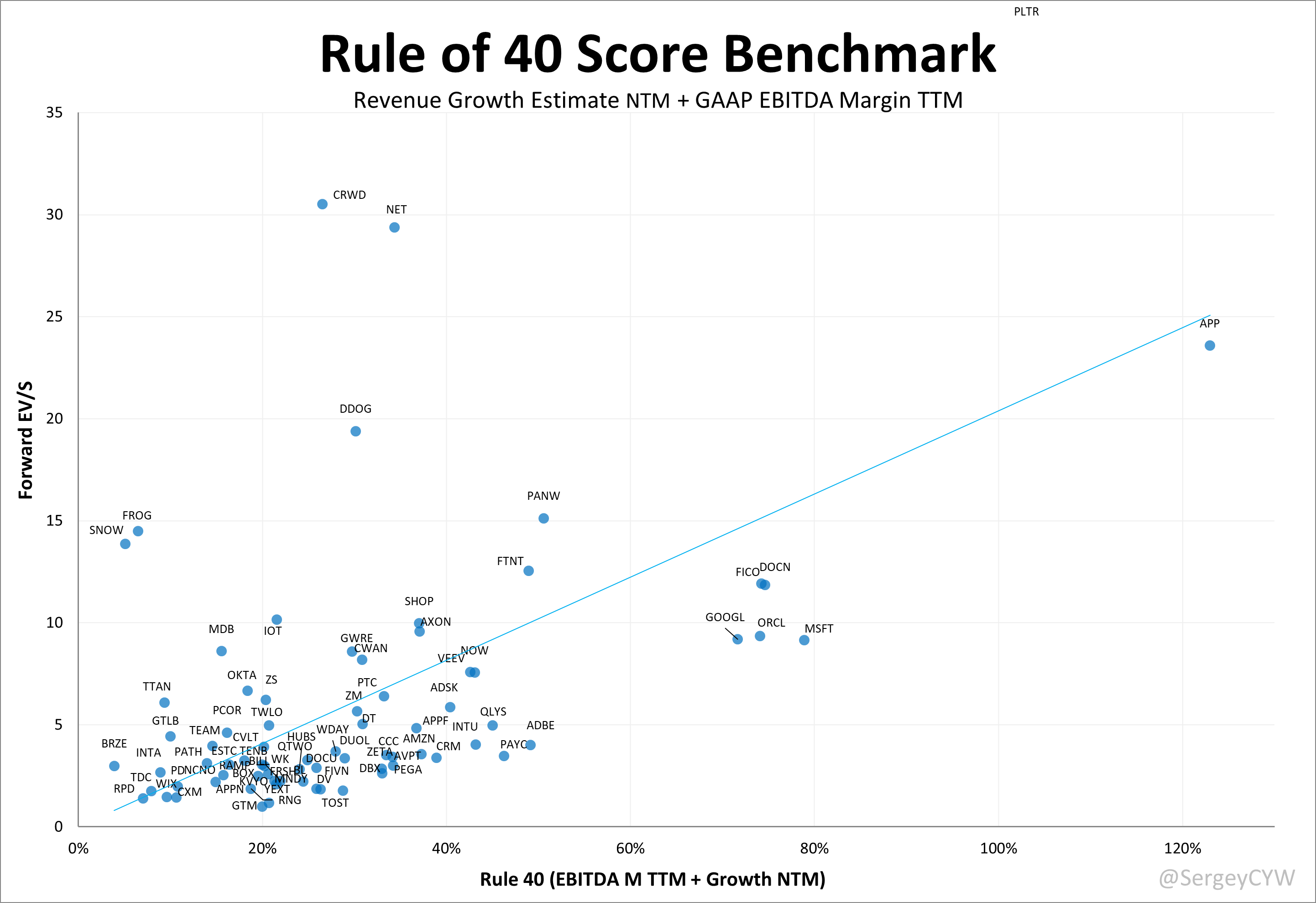
Note: This chart also uses GAAP EBITDA Margin (TTM) and next year’s revenue growth estimates.
Pricing models
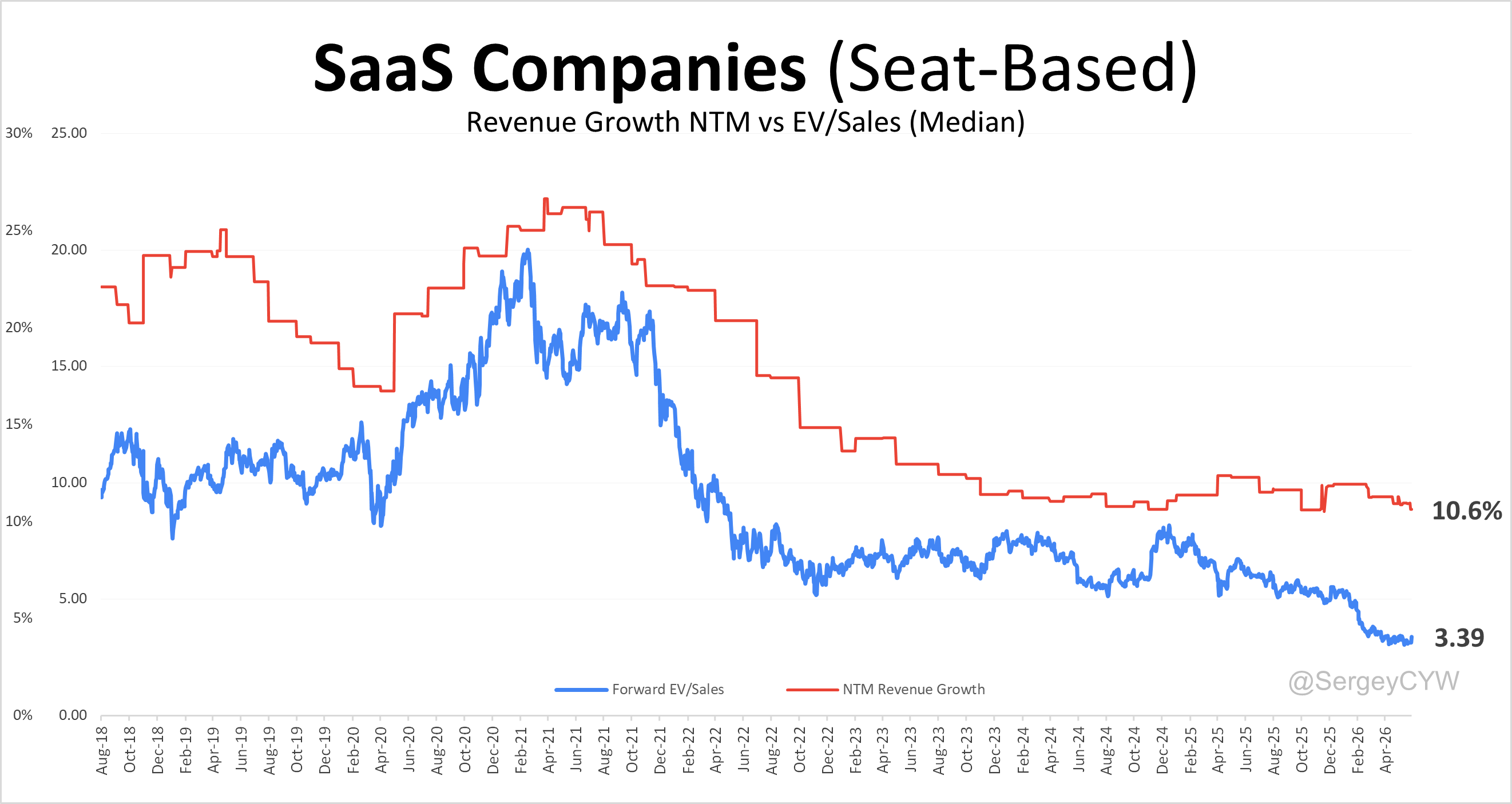
Comparison of median EV/Sales Multiples for subscription-based SaaS companies (including device / fixed-capacity subscriptions and consumption-based models) vs. seat-based subscription SaaS models.
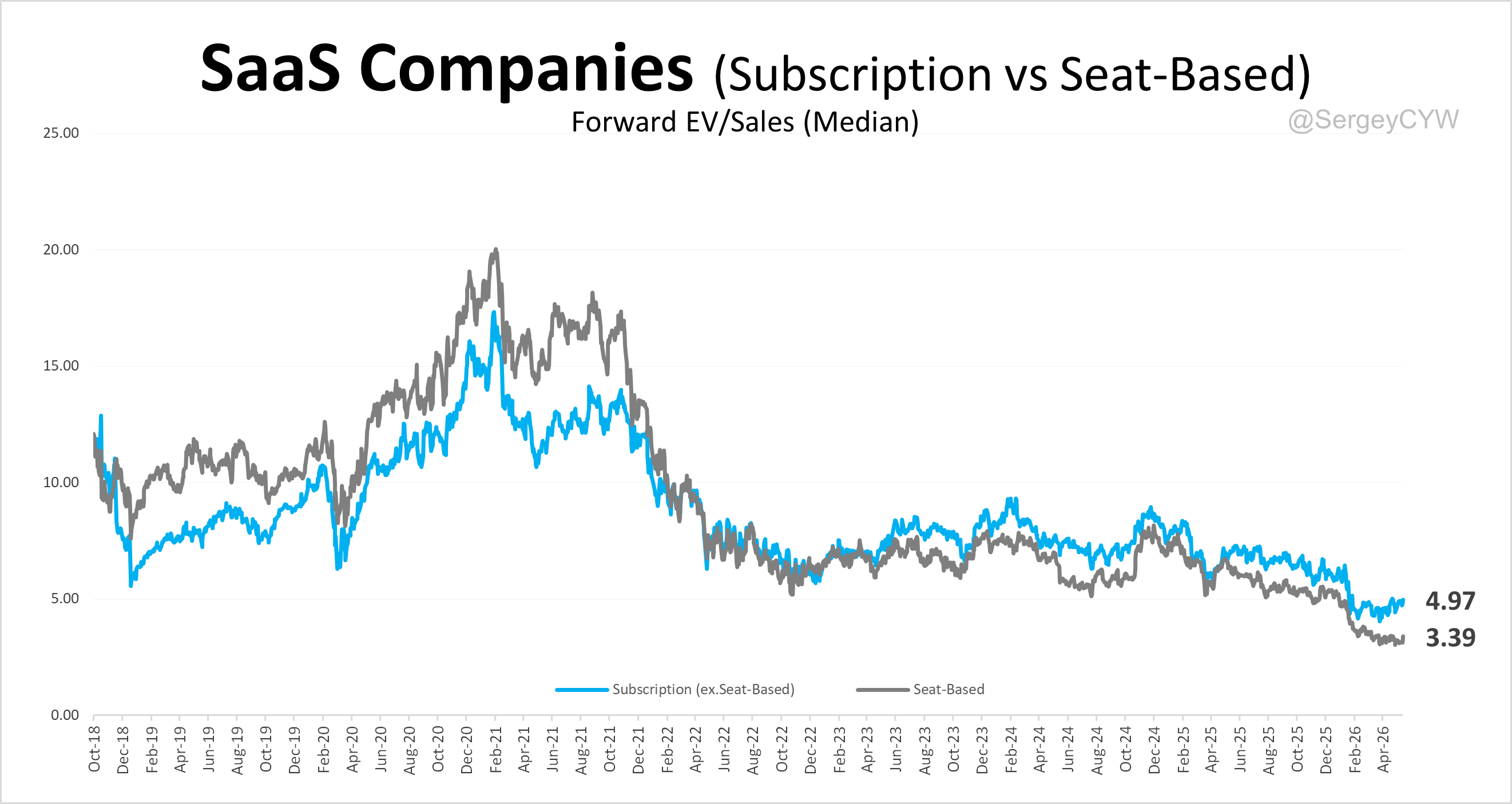
The median EV/Sales multiple for subscription-based SaaS companies (including device / fixed-capacity subscriptions and consumption-based models) is 4.97x, with analyst-estimated NTM revenue growth of 16.1% YoY.
The dataset includes 50 public SaaS companies.
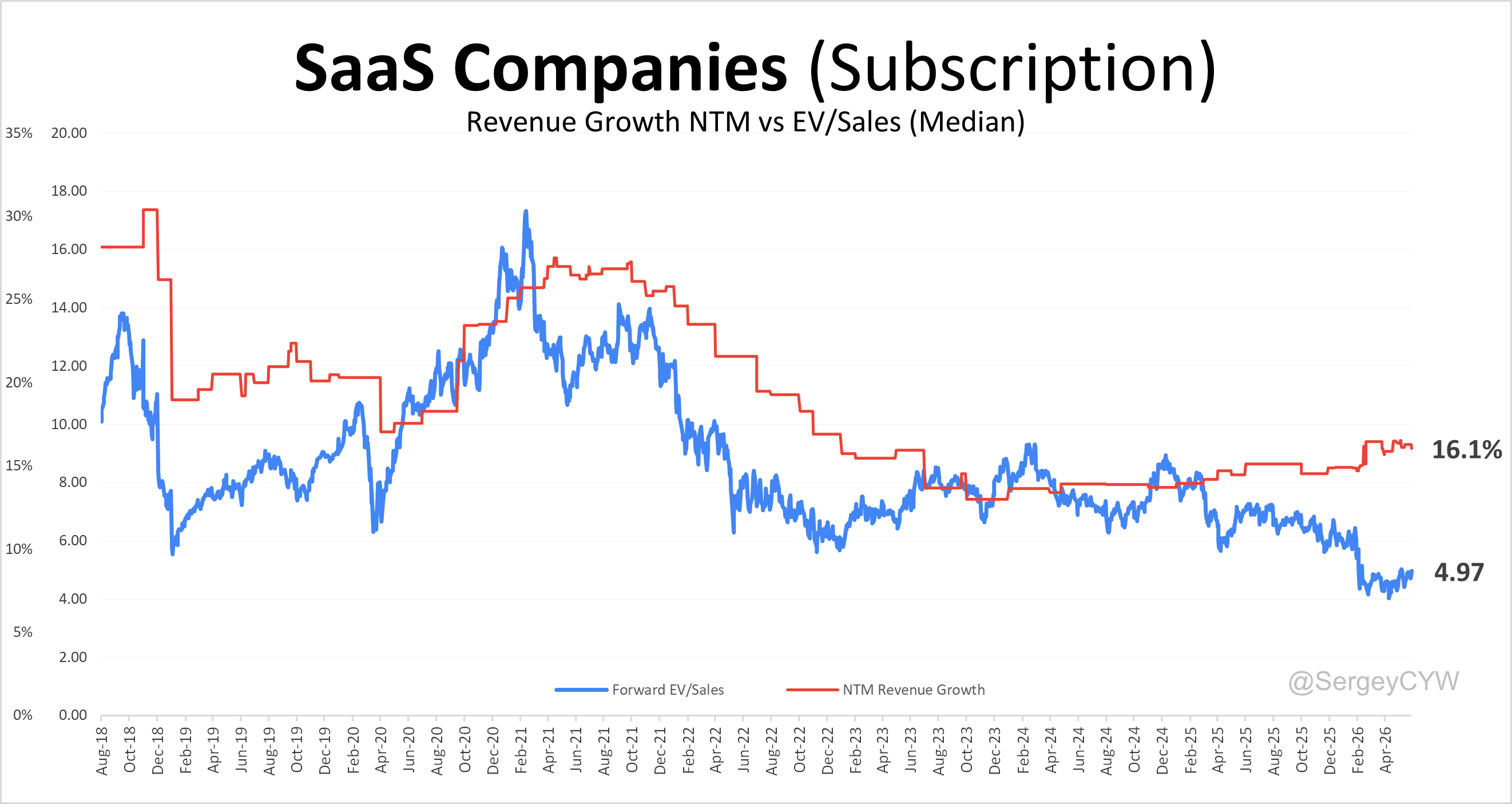
For seat-based subscription SaaS models, the median EV/Sales multiple is 3.39x, paired with 10.6% expected NTM revenue growth.
The dataset includes 36 public SaaS companies.
Dilution
Stock-Based Compensation (SBC) relative to estimated revenue growth is a key metric for assessing SaaS company efficiency and shareholder dilution.
SBC plays a vital role in attracting and retaining top talent while tying employee incentives to long-term performance.
However, it must be managed with discipline — excessive SBC can dilute shareholders and depress earnings per share, both of which weigh heavily on investor perception of financial health and sustainable value creation.
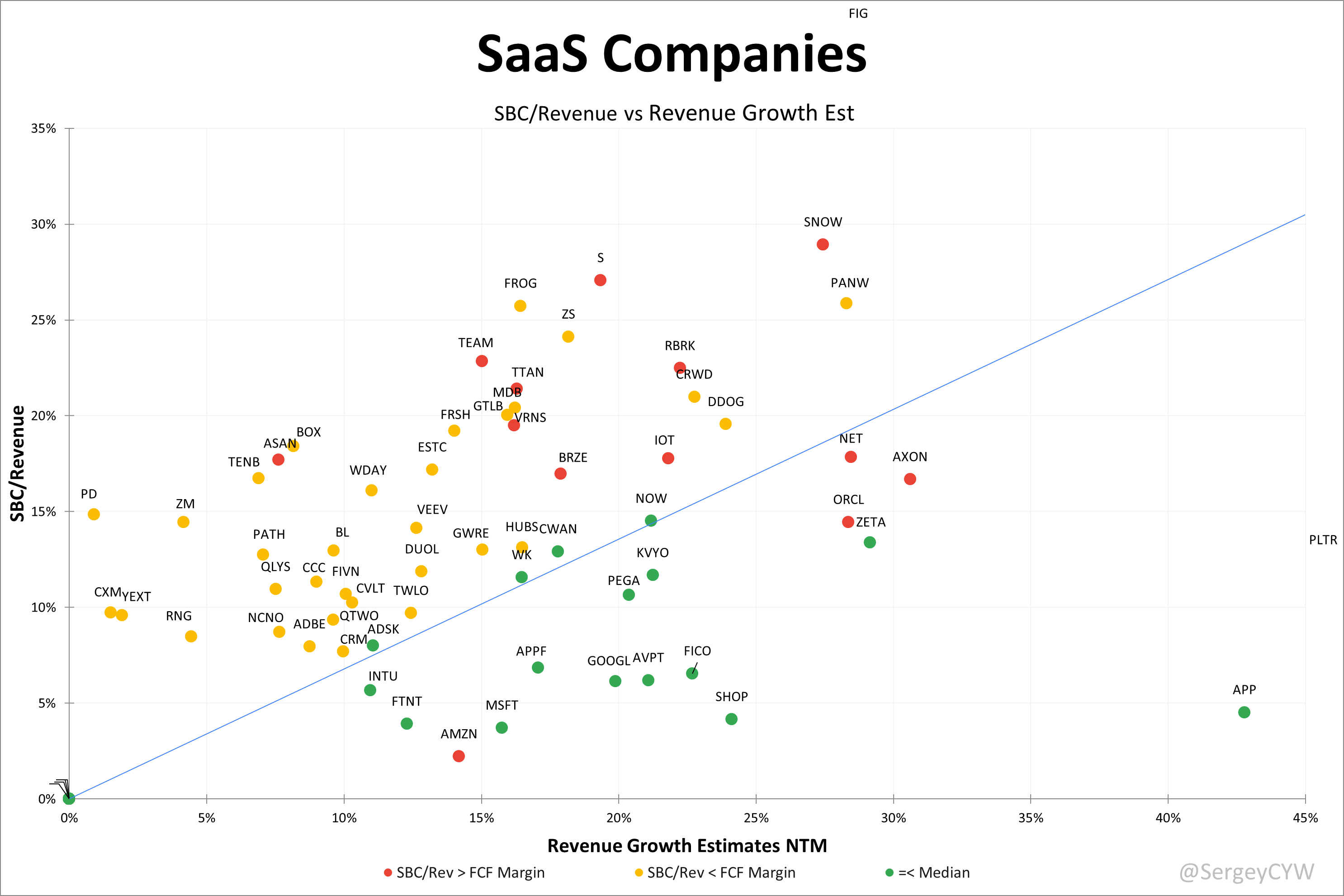
On the chart:
Red: SBC/Revenue > Free Cash Flow (FCF) margin
Yellow: SBC/Revenue < FCF margin
Green: SBC/Revenue =< Median
Outstanding share growth matters more than the absolute SBC expense because it directly reflects the erosion of shareholder ownership.
By comparing outstanding share count growth directly against estimated revenue growth, we can clearly see what portion of expected revenue expansion will be absorbed by dilution.
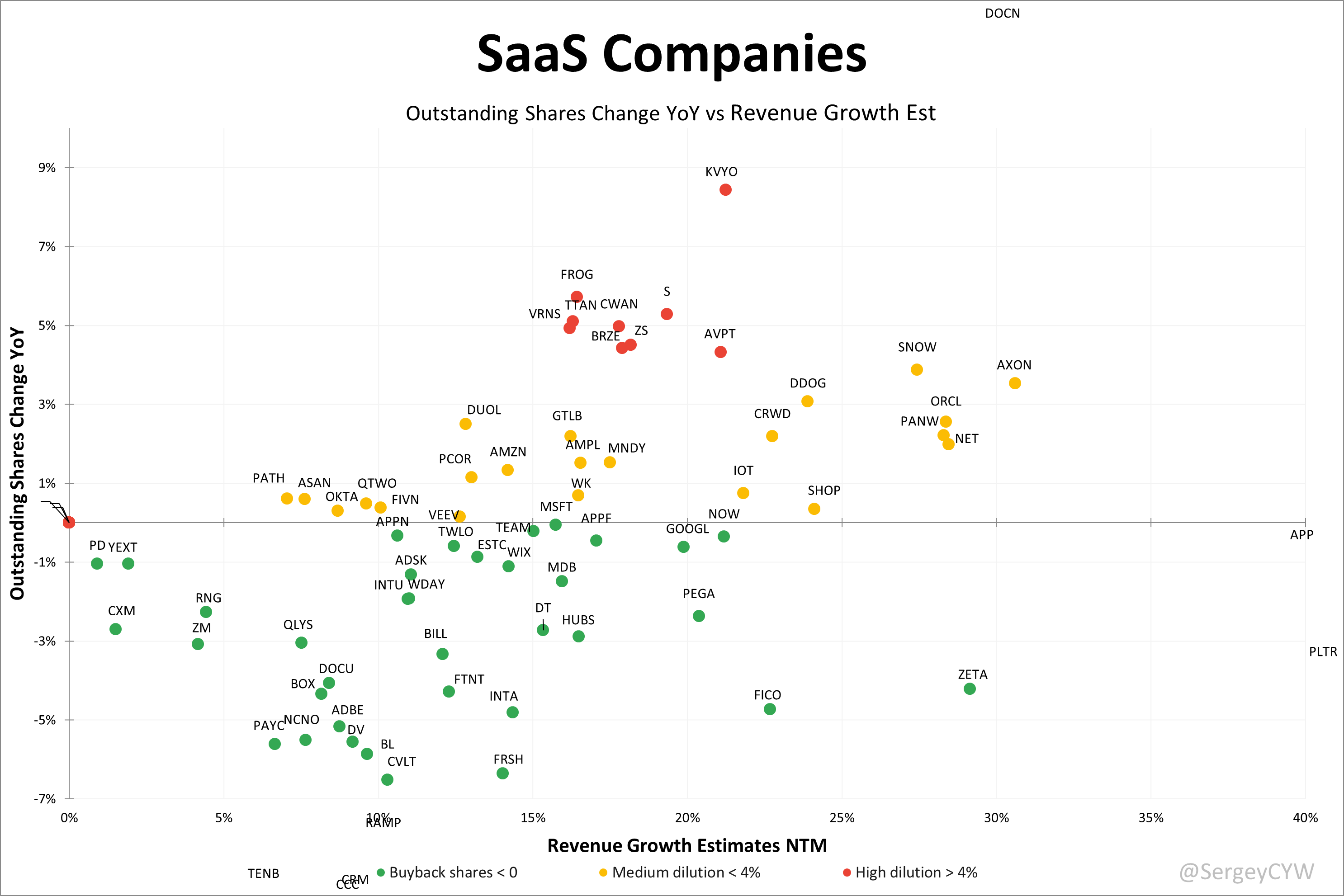
On the chart:
• Companies that buy back shares are marked in green
• Moderate dilution under 4% YoY is marked in yellow
• High dilution above 4% YoY is marked in red
Thank you for reading!
Follow me for more frequent updates on X/Twitter and Threads, and on LinkedIn. For visual infographics, check out Instagram, and for portfolio changes, follow me on SavvyTrader.
Disclaimer: This earnings review is for informational purposes only and does not constitute financial, investment, or trading advice.
I always enjoy reading your posts. I am new to buying SaaS AI stocks; I started buying in March. DDOG is up 107%. SNOW is up 78%, PANW is up 69%, MDB is up 33%, and NOW is presently up 24%. IOT, which I bought on 4/27, is up 20.2%; TEAM, which I bought on 5/27, is up 18.8%. Even ZS is up 5.53%. I want to thank you for your help. I usually run your post through an AI; it helps me understand. The AI often references you on issues.