

Financial Results:
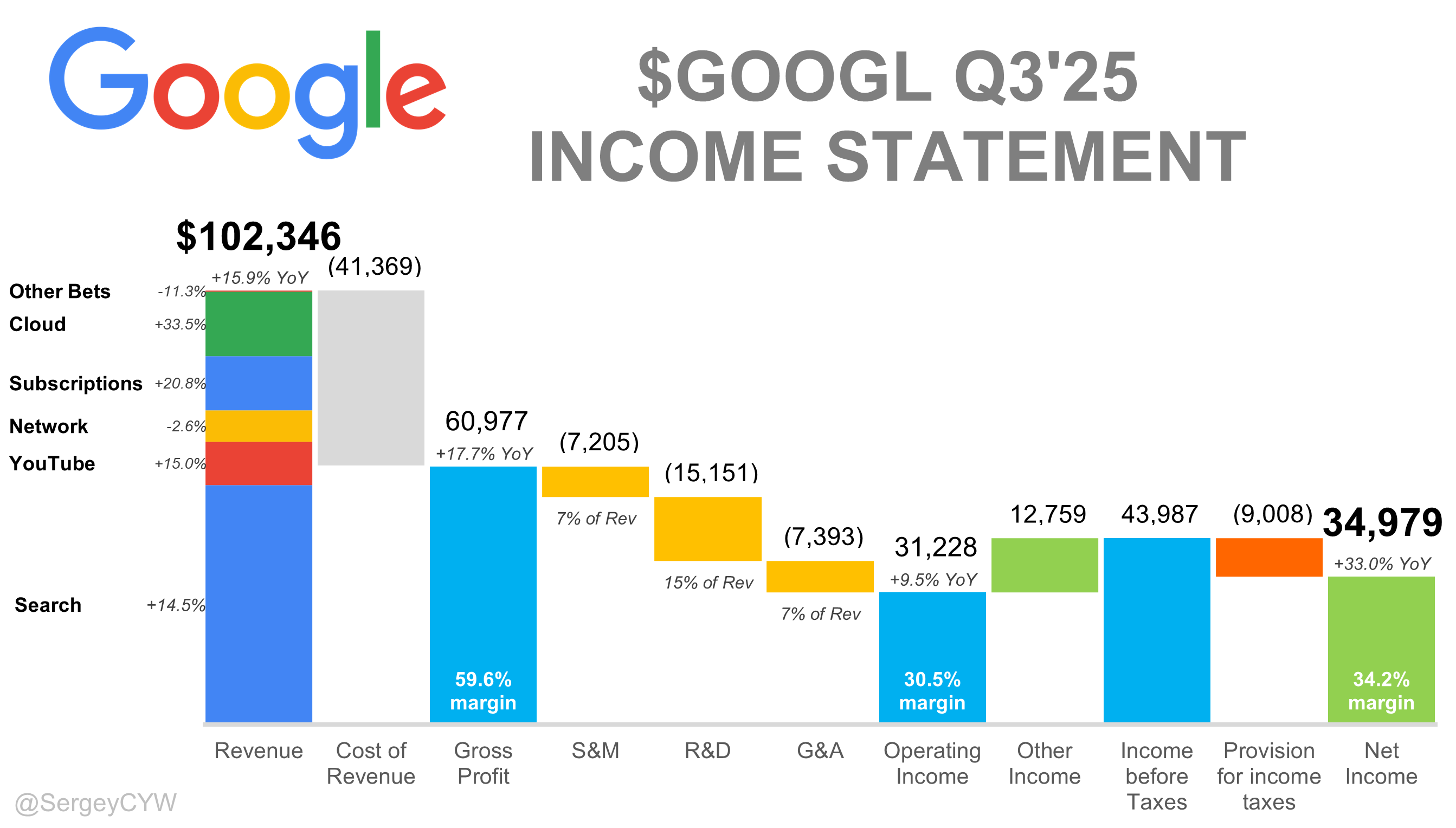
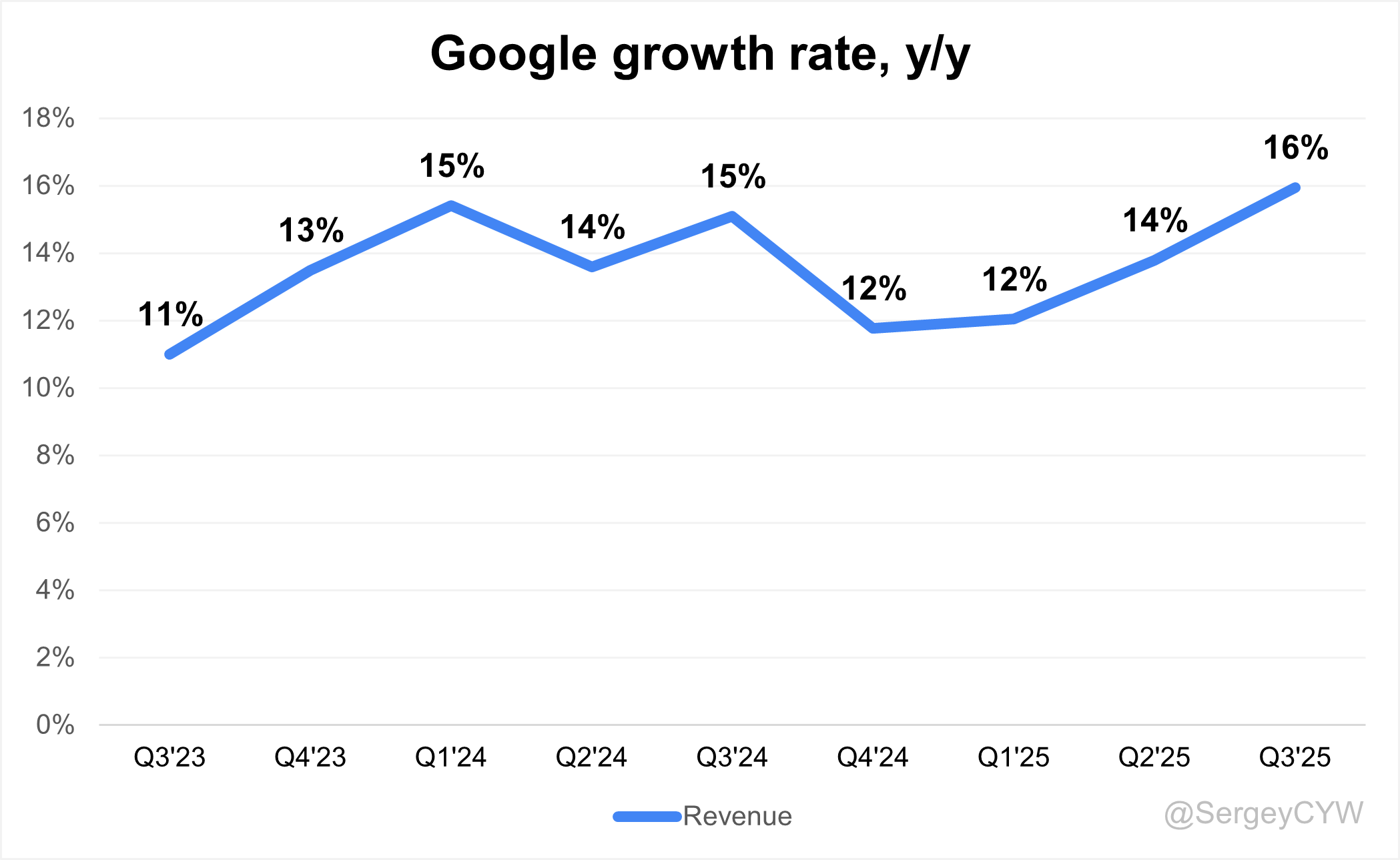
↗️$102,346M rev (+15.9% YoY, +6.1% QoQ) beat est by 2.4%
↗️Gross Margin (59.6%, +0.9 PPs YoY)
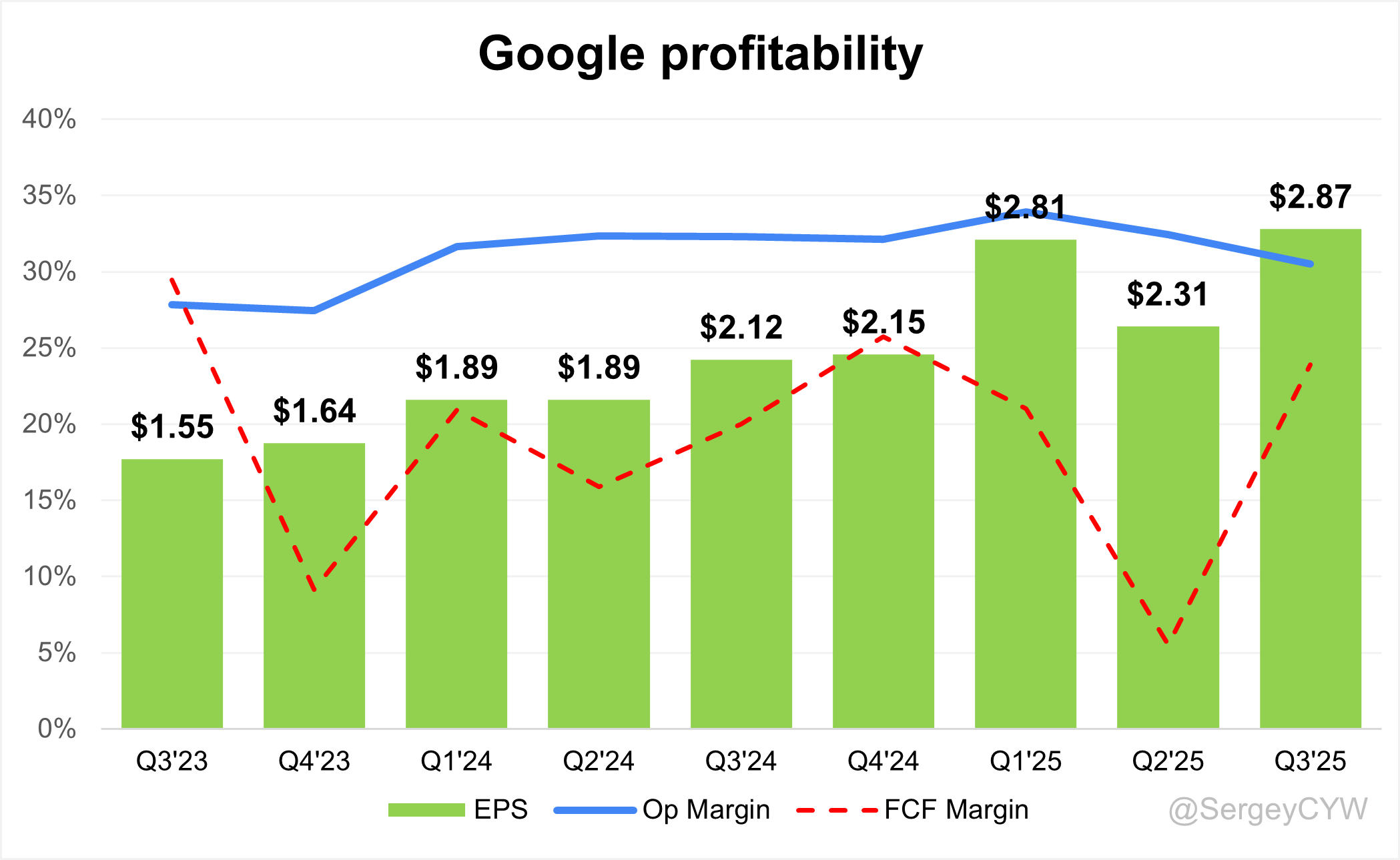
↘️Operating Margin (30.5%, -1.8 PPs YoY)🟡
↗️FCF Margin (23.9%, +3.9 PPs YoY)
↗️Net Margin (34.2%, +4.4 PPs YoY)
↗️EPS $2.87 beat est by 25.9%
Segment Revenue
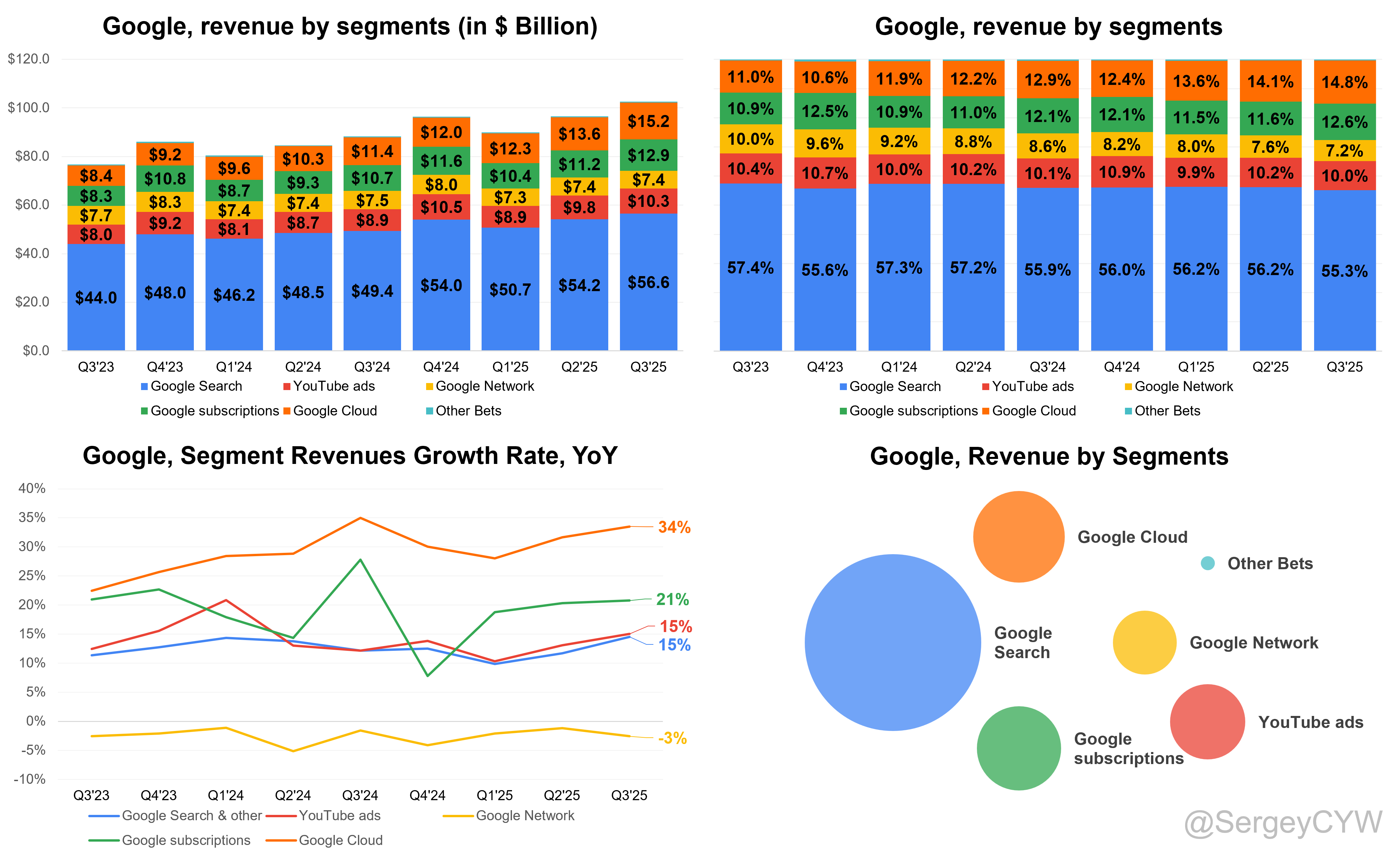
➡️Google Search $56,567M rev (+14.5% YoY, 55.3% of Rev)🟡
➡️YouTube ads $10,261M rev (+15.0% YoY, 10.0% of Rev)🟡
↘️Google Network $7,354M rev (-2.6% YoY, 7.2% of Rev)🟡
➡️Google advertising $74,182M rev (+12.6% YoY, 72.5% of Rev)🟡
↗️Google subscriptions $12,870M rev (+20.8% YoY, 12.6% of Rev)🟢
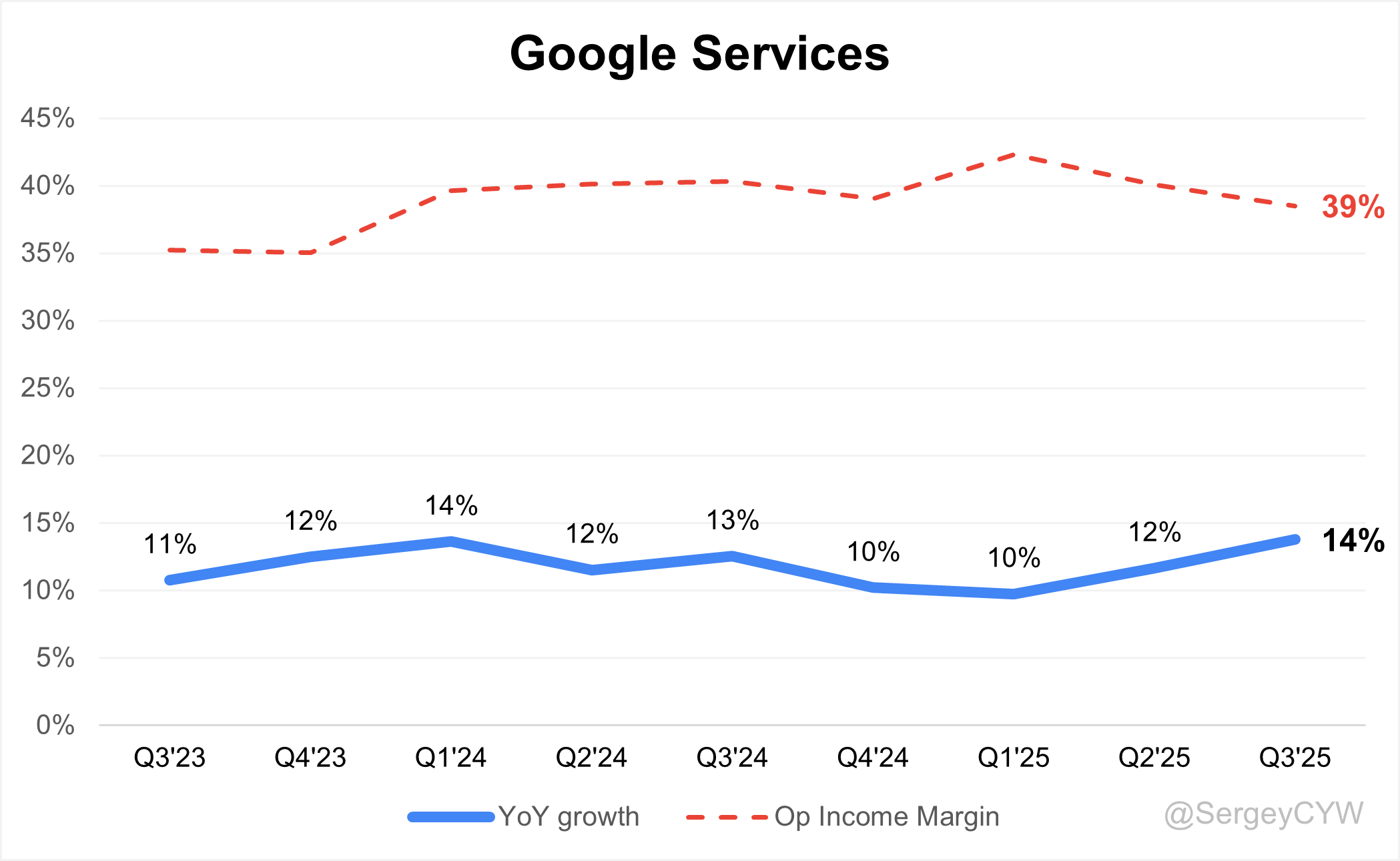
➡️Google Services $87,052M rev (+13.8% YoY, 38.5% Op Margin, 🟡85.1% of Rev)
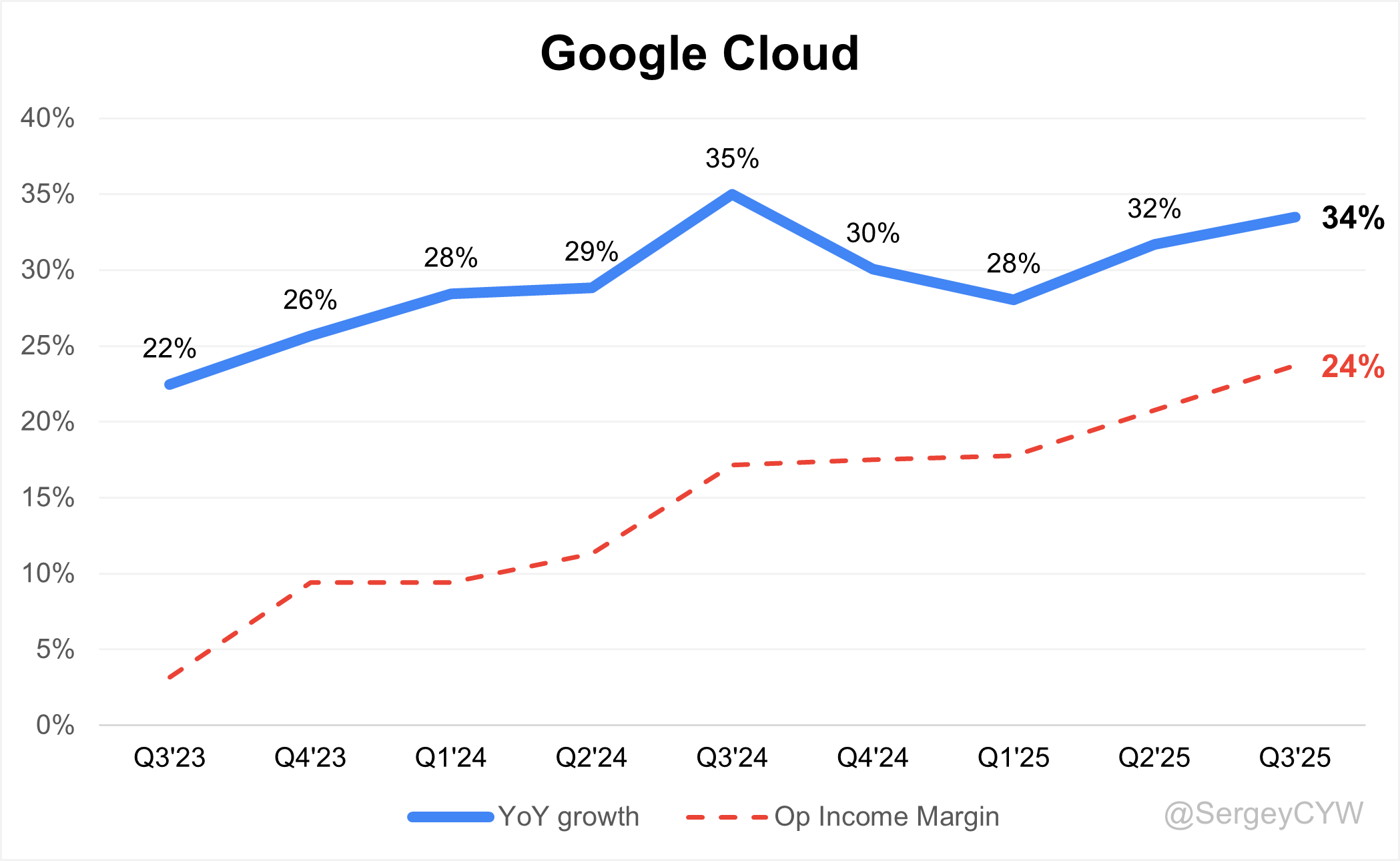
↗️Google Cloud $15,157M rev (+33.5% YoY, 23.7% Op Margin, 🟢14.8% of Rev)
↘️Other Bets $344M rev (-11.3% YoY, -414.5% Op Margin, 🟡0.3% of Rev)
Revenue by Geography
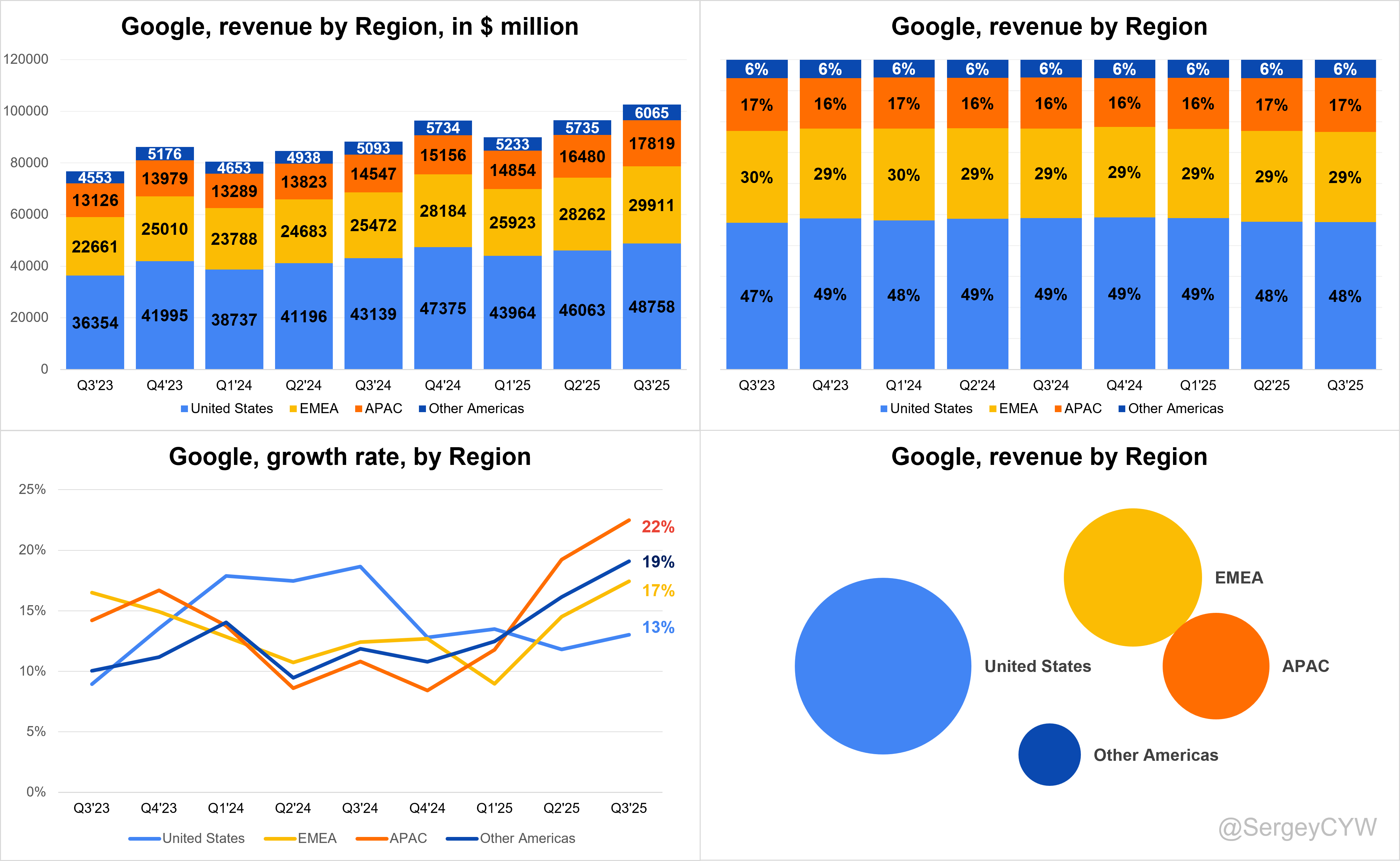
➡️United States $48,758M (+13.0% YoY, 47.6% of Rev)
↗️EMEA $29,911M (+17.4% YoY, 29.2% of Rev)
↗️APAC $17,819M (+22.5% YoY, 17.4% of Rev)
↗️Other Americas $6,065M (+19.1% YoY, 5.9% of Rev)
Operating expenses
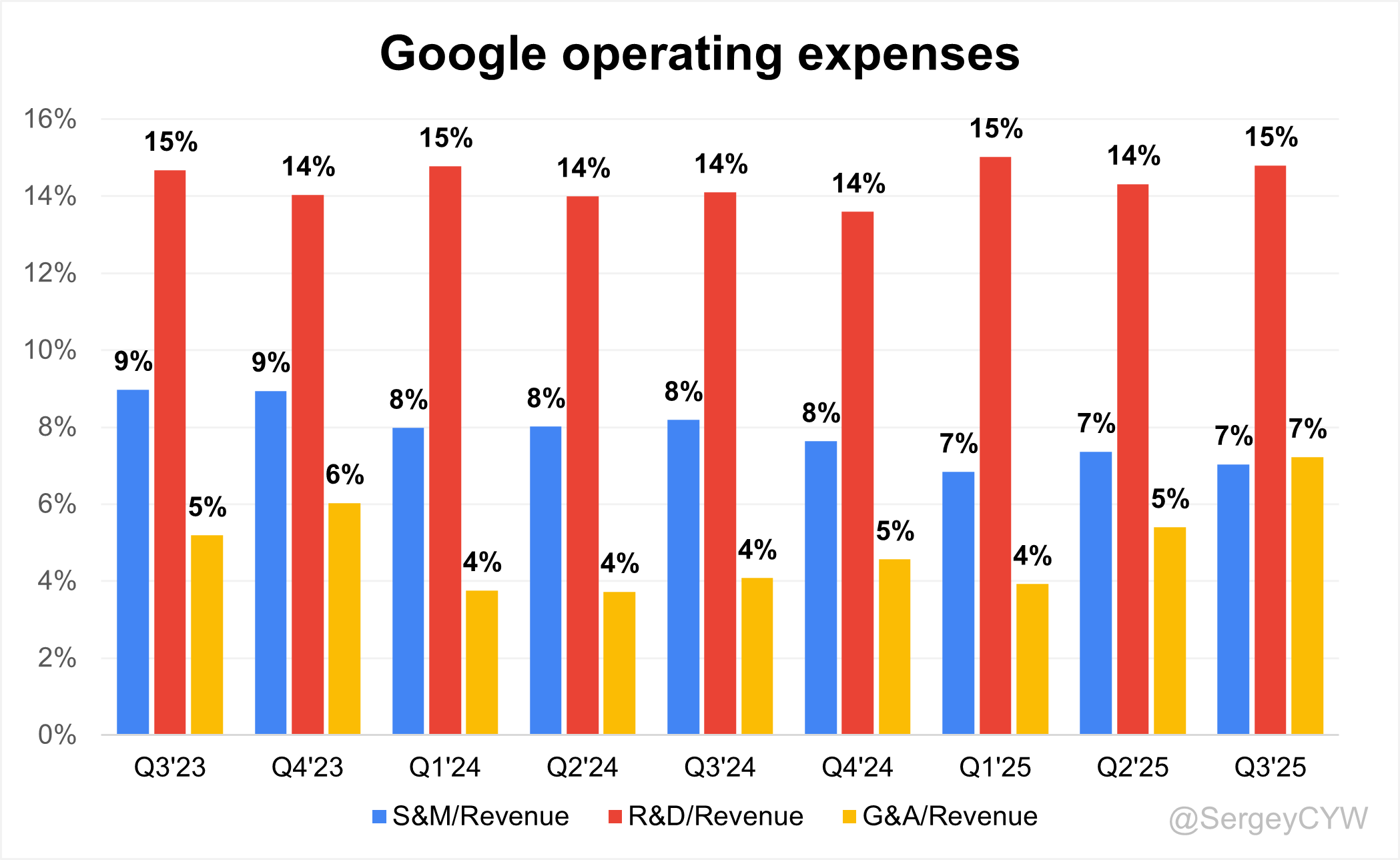
↘️S&M/Revenue 7.0% (-1.1 PPs YoY)
↗️R&D/Revenue 14.8% (+0.7 PPs YoY)
↗️G&A/Revenue 7.2% (+3.1 PPs YoY)
Headcount
↗️190,167 Total Headcount (+4.9% YoY, +3064 added)
Dilution
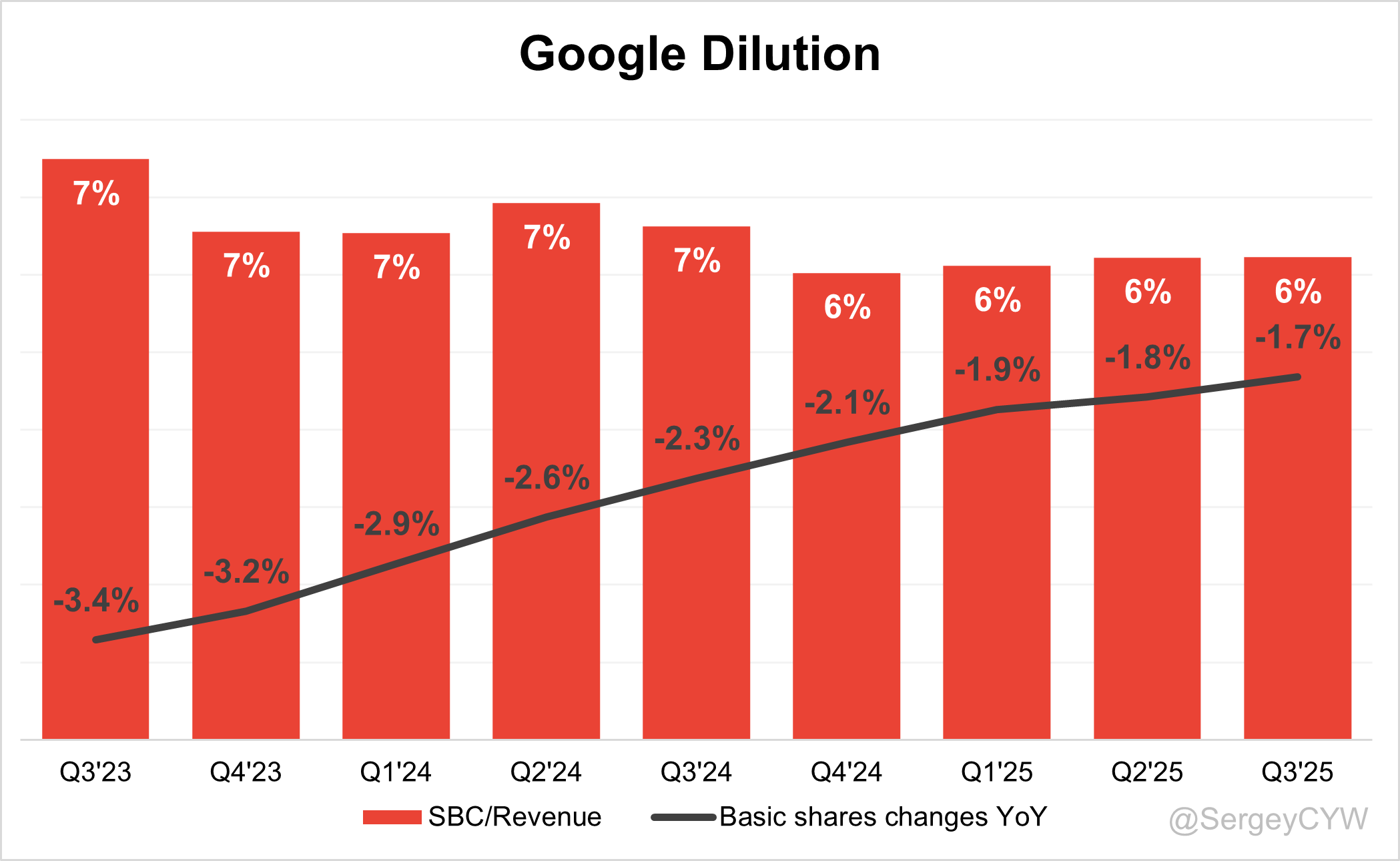
↗️SBC/rev 6%, +0.0 PPs QoQ
↗️Basic shares down -1.7% YoY, +0.1 PPs QoQ🟢
↗️Diluted shares down -1.7% YoY, +0.6 PPs QoQ🟢
Key points from Google’s Third Quarter 2025 Earnings Call:
Financial Performance
Alphabet reported revenue of $102.3B, up 16% year over year or 15% in constant currency, marking its first-ever $100B quarter. Operating income reached $31.2B with a 30.5% margin. Excluding the $3.5B European Commission fine, operating income rose 22%, expanding margin to 33.9%. Net income increased 33% to $35.0B, and EPS rose 35% to $2.87. Other income totaled $12.8B, driven by unrealized gains in equity securities.
Free cash flow stood at $24.5B for Q3 and $73.6B over the trailing twelve months. Cash and marketable securities ended at $98.5B. Cost of revenues grew 13% to $41.4B, with traffic-acquisition costs of $14.9B (+8%) and other costs up 16% to $26.5B. Operating expenses rose 28% to $29.7B, led by 22% growth in R&D from AI-related compensation and depreciation, while sales and marketing remained flat. Capital returns included $11.5B in buybacks and $2.5B in dividends.
Anat Ashkenazi, Chief Financial Officer
“We are demonstrating that scaling AI innovation can coexist with disciplined financial execution. The results show strong operational leverage despite substantial investment in infrastructure and R&D.”
Google Cloud
Google Cloud revenue reached $15.2B, up 34% year over year, as enterprise AI demand accelerated. Operating income increased 85% to $3.6B, expanding margin from 17.1% to 23.7%. Cloud backlog rose 46% quarter over quarter and 82% year over year to $155B, reflecting robust contract growth.
New GCP customers increased 34%, and billion-dollar deals signed in the first nine months exceeded the prior two years combined. More than 70% of Cloud clients now use Google AI products, and nearly 150 customers processed around 1T tokens each in the past year. Partnerships included HCA Healthcare, LG AI Research, and Macquarie Bank. Thirteen product lines now exceed $1B in annual run rate.
The key constraint remains capacity, as demand for AI infrastructure continues to outpace server and data center expansion despite higher CapEx.
Sundar Pichai, Chief Executive Officer
“Our enterprise AI stack is becoming the default for global businesses. The momentum we’re seeing from billion-dollar customers confirms Google Cloud’s strategic role in powering the next wave of AI transformation.”
Search
Search revenue totaled $56.6B, rising 15% year over year, driven by AI Overviews and AI Mode. Both total and commercial queries increased, reversing concerns over AI cannibalization. AI Overviews reached over 2B users, maintaining monetization similar to traditional search. AI Mode achieved 75M daily active users across 40 languages, doubling query volumes in one quarter.
AI Max, launched globally in September, became the fastest-growing AI-powered Search Ads product, generating billions of new queries. Advertisers saw stronger performance—Kayak’s conversion value up 12%, SoFi’s conversions up 39%. Growth was strongest in retail and financial services, with healthcare also contributing. Sustaining monetization parity and managing compute costs remain key challenges.
Sundar Pichai, Chief Executive Officer
“We’re seeing the beginning of a new phase for Search. As users explore AI-enhanced experiences, engagement grows, and advertisers are finding new, high-intent opportunities.”
Philipp Schindler, Chief Business Officer
“Advertisers are reporting higher ROI from AI Max and Performance Max campaigns. The shift to AI-powered Search is expanding both inventory and relevance simultaneously.”
Gemini and Veo 3
Gemini adoption surged, with the app reaching 650M monthly active users and 3× growth in query volume from Q2. Across Google’s ecosystem, token processing hit 1.3 quadrillion monthly, up 20× year over year. Direct API usage processed 7B tokens per minute, underscoring developer engagement. Over 13M developers have now built with Google’s generative AI models.
Veo 3 continued rapid uptake with 230M+ videos generated, integrated into YouTube and marketing tools. Gemini Enterprise surpassed 2M paid seats across 700 companies, showing strong traction for AI-driven workplace tools. Gemini 3, scheduled for release later this year, is expected to extend frontier model capabilities. The main constraint remains infrastructure capacity and cost efficiency amid exponential usage growth.
Sundar Pichai, Chief Executive Officer
“Gemini’s usage has exceeded our expectations. The pace of developer adoption and enterprise integration shows how quickly generative AI is becoming a core business tool.”
YouTube
YouTube delivered $10.3B in ad revenue, up 15% year over year, led by direct response and retail categories. Shorts monetization outperformed, now earning more per watch hour than in-stream content in the U.S. The first exclusive NFL broadcast reached 19M viewers, setting a new platform record.
Interactive living-room ads surpassed a $1B annualized run rate, while subscriptions—driven by YouTube Premium, Music, and TV—supported platform growth. Alphabet now counts 300M+ paid subscribers across services.
New tools like Demand Gen improved advertiser performance by 40%, and creator collaborations such as Dude Perfect’s campaign for Comcast boosted recall and efficiency. The dual-engine model of ads and subscriptions enhanced revenue resilience, though content costs and competition for premium rights remain challenges.
Philipp Schindler, Chief Business Officer
“YouTube’s growth reflects the health of our ecosystem—creators, advertisers, and viewers are all seeing more value. The platform’s ability to scale both ads and subscriptions is creating a balanced, durable business model.”
Waymo
Waymo expanded toward full commercial rollout in 2026, with plans to launch in London and preparation underway for Tokyo. The company added service in Dallas, Nashville, Denver, and Seattle, secured clearance for autonomous operations at SJC and SFO, and continued testing in New York City.
New offerings include Waymo for Business, providing enterprise rides, and Waymo Teens, designed for safe youth travel. Early results in Phoenix showed high satisfaction and increasing trip frequency. Integration with Gemini for in-car and travel experiences is planned for 2026, aligning AI with mobility. Profitability remains a long-term goal as infrastructure and regulatory costs weigh on near-term margins.
Sundar Pichai, Chief Executive Officer
“Waymo’s technology continues to mature, and the user feedback is exceptional. We’re confident autonomous mobility will be one of our most transformative long-term opportunities.”
Product Innovations
AI-driven innovation advanced across products. Chrome rolled out Gemini-powered tools, while Search introduced conversational shopping and try-on experiences. The Pixel 10, powered by the Gemini Tensor G5, became Google’s highest-rated device, and Android XR, launched with Samsung’s Galaxy XR, brought Gemini into mixed reality.
AI Max in Search, now global, became the fastest-growing AI ad product, unlocking billions of new queries and onboarding hundreds of thousands of advertisers. Tools like Asset Studio and Product Studio integrated Imagen 4 for faster creative production. Enhanced Meridian and PMax reporting improved marketing insights and bidding precision.
Sundar Pichai, Chief Executive Officer
“We’re reimagining every product through the lens of AI. Gemini is becoming the connective tissue across Search, Chrome, and Android, driving a new era of user experience.”
AI Agents
Gemini Enterprise adoption grew to 2M subscribers across 700 companies. Sales teams using Gemini-enhanced workflows achieved 10%+ productivity gains, generating hundreds of millions in incremental revenue. Gemini-powered support handled 40M customer sessions, resolving hundreds of thousands of cases.
In commerce, Google introduced agentic checkout and an open protocol for agent-to-agent transactions, alongside a PayPal partnership enabling merchants to deploy agentic experiences.
Philipp Schindler, Chief Business Officer
“We’re seeing enterprises treat Gemini as an organizational layer—one that automates knowledge, interaction, and decision-making. Adoption is accelerating because value realization is immediate.”
Quantum
The Willow quantum chip achieved a verified 13,000× algorithmic speed improvement over top supercomputers, advancing the feasibility of practical quantum computing. Recognition peaked with a Nobel Prize in Physics awarded to the company’s Chief Scientist for foundational research enabling current breakthroughs.
Sundar Pichai, Chief Executive Officer
“Quantum is a long game, but the progress of our Willow chip proves the potential for real-world computational advantage. The science is catching up to the vision.”
CapEx and Infrastructure
Capital expenditures reached $24B in Q3, with 60% for servers and 40% for data centers. Full-year 2025 CapEx guidance rose to $91–93B, up from $85B, with a significant step-up expected in 2026. Depreciation increased 41% to $5.6B, reflecting rapid deployment and scaling.
New compute capacity includes A4X Max instances with NVIDIA GB300 GPUs and the upcoming TPU v7 “Ironwood”. Demand remains intense—Anthropic plans to utilize up to 1M TPUs.
Anat Ashkenazi, Chief Financial Officer
“The investment pace mirrors the magnitude of AI opportunity. Our goal is to maintain cost discipline while ensuring we’re ready for sustained AI-driven demand.”
Challenges and EC Fine
The $3.5B EC fine reduced reported profitability, bringing Google Services operating income to $33.5B with a 38.5% margin. Excluding the fine, performance strengthened. Rising depreciation, infrastructure costs, and tight compute supply will continue to pressure margins. Network advertising declined 3%, and Q4 will face tougher comparisons due to 2024 election ad spending.
Anat Ashkenazi, Chief Financial Officer
“We remain confident in our structural profitability, but scaling next-generation infrastructure does come with near-term cost intensity. The focus is on long-term returns.”
Future Outlook
Management expects revenue momentum to continue into Q4, supported by potential FX tailwinds but offset by tough advertising comparisons. Cloud backlog growth of $49B sequentially signals sustained demand amid capacity constraints.
Investments in global data centers and TPU infrastructure will remain high. AI-assisted tools now produce nearly 50% of new code, helping offset inflationary pressures. Key upcoming drivers include Gemini 3’s launch, AI Overviews ad expansion, and broader AI Mode monetization.
Sundar Pichai, Chief Executive Officer
“This is an expansionary moment for our company. AI is unlocking growth across every business line, and we’re executing with confidence to capture that opportunity.”
Anat Ashkenazi, Chief Financial Officer
“Our disciplined investment strategy positions us to convert AI demand into sustainable, long-term value creation.”
Thoughts on Google Earnings Report $GOOGL:
🟢 Positive
Revenue $102.3B (+15.9% YoY, +6.1% QoQ); first-ever $100B quarter; EPS $2.87 (+35% YoY); beat by 25.9%
Net margin 34.2% (+4.4 pp YoY); FCF margin 23.9% (+3.9 pp YoY); FCF $24.5B (Q3); cash $98.5B
Google Cloud $15.2B (+33.5% YoY), margin 23.7%; backlog $155B (+46% QoQ, +82% YoY); new GCP customers +34%
Search $56.6B (+14.5% YoY); AI Overviews >2B users; AI Mode 75M DAUs; AI Max unlocking billions of queries
YouTube ads $10.3B (+15% YoY); Shorts higher rev/hour than in-stream (U.S.); TV DR ads >$1B run-rate; NFL stream 19M viewers
Subscriptions $12.9B (+20.8% YoY); total paid subs 300M+
Operating leverage ex-EC fine: op margin 33.9%; Cloud op income $3.6B (+85% YoY)
Share count down -1.7% YoY; returns: $11.5B buybacks, $2.5B dividends
🟡 Neutral
Gross margin 59.6% (+0.9 pp YoY); stable mix shift toward AI infra and subs
S&M/Rev 7.0% (-1.1 pp YoY); R&D/Rev 14.8% (+0.7 pp YoY); SBC/Rev 6%
Regional growth balanced: EMEA +17.4%, APAC +22.5%, Other Am. +19.1%, U.S. +13.0%
Headcount 190,167 (+4.9% YoY); productivity tailwind from AI-assisted code ~50% of new code
FX in Q4 likely a tailwind; tougher ad comps from 2024 election spend
🔴 Negative
Operating margin 30.5% (-1.8 pp YoY) impacted by $3.5B EC fine; G&A/Rev 7.2% (+3.1 pp YoY)
Network ads $7.35B (-2.6% YoY)
Capacity constraints in AI infra; depreciation +41% YoY to $5.6B; tight GPU/TPU supply into 2026
CapEx $24B (Q3); FY25 $91–93B (up from $85B); step-up expected 2026
Waymo scaling but profitability distant; regulatory and infrastructure costs persist
Thank you for reading!
Follow me for more frequent updates on X/Twitter and Threads, and on LinkedIn. For visual infographics, check out Instagram, and for portfolio changes, follow me on SavvyTrader.
Disclaimer: This earnings review is for informational purposes only and does not constitute financial, investment, or trading advice.
This piece really made me think about the scale of these tech giants. Your breakdown of Google's first 100B quarter is incredibly insightful. I was definately struck by the increase in R&D spend, which I see as a strong indicator for future AI initiatives. It suggests a strategic long-term investment, even with the slight operating margin shift.